
NOAA predicts a near-normal 2012 Atlantic hurricane season
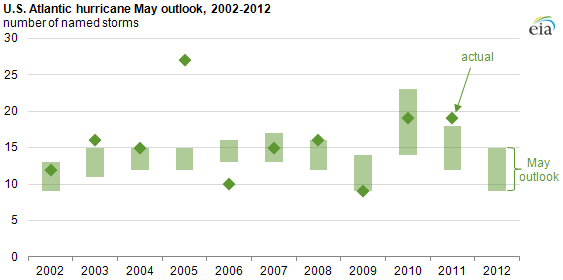
On May 24, 2012, the National Oceanic and Atmospheric Administration's Climate Prediction Center said that, for the six-month hurricane season beginning June 1, there is a 70% chance of 9 to 15 named storms in the Atlantic Basin, of which 4 to 8 may strengthen to hurricanes. Of those, 1 to 3 may become major hurricanes (Category 3, 4, or 5). During the hurricane season from 1981 through 2010, the Atlantic basin averaged 12 named storms and 6 hurricanes each year—3 of which were major hurricanes.
As of June 1, 2012, there have been two named Atlantic Basin storms (Tropical Storms Alberto and Beryl).
Tropical storms and hurricanes can temporarily disrupt the U.S. oil and natural gas supply chain (producing fields, gathering, processing, refining, and transportation), especially in the Gulf Coast region. The U.S. Energy Information Administration's Federal Offshore Gulf of Mexico reporting region (GOM Fed) is a key component of U.S. crude oil and natural gas production.
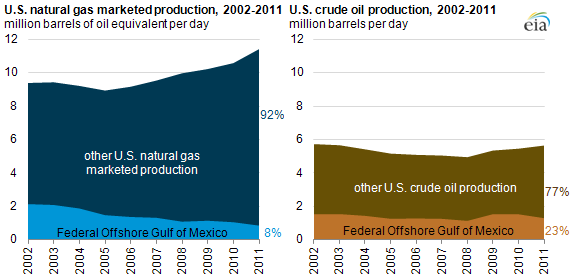
Notes: The graph of natural gas marketed production uses a factor of 5,800 cubic feet per barrel of oil equivalent. Crude oil production includes lease condensate.
The GOM Fed region provided nearly one quarter of total U.S. crude oil production in 2011, the highest share among Federal offshore regions and second only to Texas among individual states. Driven by increasing volumes associated with deepwater and ultra-deepwater development activity, the GOM Fed region helped to reverse a decades-long decline in U.S. crude oil production in 2009. GOM Fed region production declined in 2010 and 2011, largely the result of suspended drilling activity following the Macondo oil spill. Exploration and development operations have since resumed, however.
The potential impact of hurricanes on U.S. natural gas supply is comparatively muted, as the GOM Fed region accounts for a relatively modest portion of total U.S. natural gas production. The GOM Fed region supplied about 8% of total U.S. marketed natural gas production in 2011, down significantly from a decade ago, when the region had an approximate one-quarter share. The GOM Fed region's relative contribution has diminished as a result of both gradually declining offshore production and significant increases in Lower 48 output, due primarily to expanding shale gas developments in several areas of the country.