U.S. Energy Information Administration logo
Skip to sub-navigation
April 26, 2012

U.S. summer gasoline demand expected to be at 11-year low
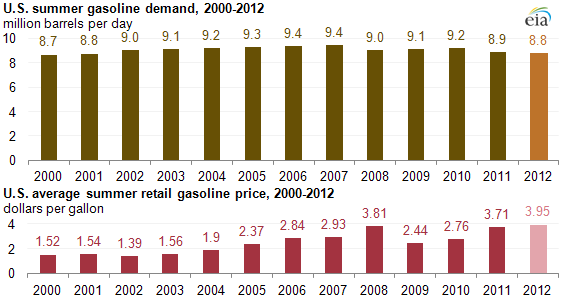
graph of U.S. summer gasoline demand, 2000-2012, as described in the article text
Source: U.S. Energy Information Administration, Short-Term Energy Outlook (STEO), April 10, 2012.
Note: The 2012 figures for summer gasoline demand and retail gasoline prices are projections from EIA's Short-Term Energy Outlook. Data and projections from STEO are subject to change with the next release of the STEO on May 8, 2012.
Download CSV Data

U.S. gasoline demand this summer is expected to be the lowest in 11 years, while the average summer fuel price is forecast to be at a record level. High prices at the pump—mostly a result of global crude oil prices—and the use of more efficient vehicles both encourage reduced gasoline consumption.

U.S. gasoline consumption is forecast to average almost 8.8 million barrels per day (bbl/d) this summer driving season, which runs from April through September, the lowest since 2001 and about 6.4% less than 2007's record summer gasoline demand of 9.4 million bbl/d (see chart above), according to EIA's April 10, 2012 Short-Term Energy Outlook (STEO). Data and projections from STEO are subject to change with the next release of the STEO on May 8, 2012.

Also, higher vehicle fuel efficiency should contribute to lower gasoline demand this summer. Higher gasoline prices, which are expected to be up an average of 24 cents per gallon this summer compared to last year, according to the April 2012 STEO, are also expected to reduce some highway travel, which will reduce fuel use.

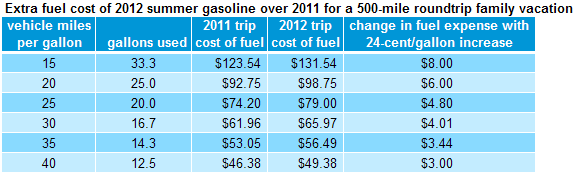
While retail gasoline prices are forecast to be higher this summer than last summer, the cost to fill up the family vehicle for a vacation trip will rise modestly. For example, in a vehicle that gets 20 miles per gallon, a vacation covering 500 miles roundtrip uses 25 gallons of motor fuel and costs an extra $6 in fuel, based on EIA's April 2012 STEO forecast of a 24-cent average higher price for gasoline this summer. The extra gasoline expense would vary depending on the fuel efficiency of the vehicle (see table below).
graph of Annual U.S. natural gas, crude oil, and NGL production, 2000-2011, as described in the article text
Source: U.S. Energy Information Administration, Short-Term Energy Outlook (STEO), April 10, 2012.
Note: Data and projections from STEO are subject to change with the next release of the STEO on May 8, 2012.
Download CSV Data

Statistics
Analysis
Tools
Education
News

Petroleum & Other Liquids

Crude oil, gasoline, heating oil, diesel, propane, and other liquids including biofuels and natural gas liquids.

Natural Gas

Exploration and reserves, storage, imports and exports, production, prices, sales.

Electricity

Sales, revenue and prices, power plants, fuel use, stocks, generation, trade, demand & emissions.

Coal

Reserves, production, prices, employment and productivity, distribution, stocks, imports and exports.

Nuclear & Uranium

Uranium fuel, nuclear reactors, generation, spent fuel.

Renewable & Alternative Fuels

Includes hydropower, solar, wind, geothermal, biomass and ethanol.

EIA Survey Forms

Forms EIA uses to collect energy data including descriptions, links to survey instructions, and additional information.

Total Energy

Comprehensive data summaries, comparisons, analysis, and projections integrated across all energy sources.

U.S. States

State energy information, including overviews, rankings, data, and analyses.

International

International energy information, including overviews, rankings, data, and analyses.

Environment

Greenhouse gas data, voluntary reporting, electric power plant emissions.

Data Tools, Apps, & Maps

Tools to customize searches, view specific data sets, study detailed documentation, and access time-series data.

Open Data

EIA's free and open data available as API, Excel add-in, bulk files, and widgets

EIA Beta

Come test out some of the products still in development and let us know what you think!

Open Source Code

EIA's open source code, available on GitHub.

RSS Feeds

Subscribe to feeds for updates on EIA products including Today in Energy and What's New.