
Both State and Federal governments have appliance efficiency standards
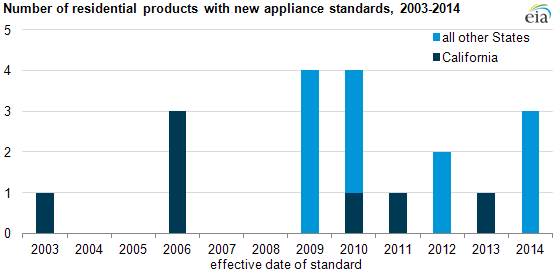
Most consumers are aware of Federal appliance efficiency standards for equipment such as refrigerators, furnaces, and air conditioners. Yet States can have efficiency standards, too. Fourteen States have passed legislation setting efficiency standards for a variety of residential and commercial products beyond those already covered at the Federal level (see chart above).
Some nationwide appliance standards, such as the general service light-bulb standard, are legislated directly by Congress. More often, though, the Department of Energy (DOE) sets standards based on authority provided by Congress. Federal efficiency standards were first authorized by legislation passed in the 1970s. Since then, about 40 product types in the residential and commercial sector, as well as about a dozen lighting products, have been subject to Federal standards.
With few exceptions, States cannot set more efficient standards than those established at the Federal level. For this reason, States have generally focused on product types that do not yet have Federal standards. In the residential sector, this includes televisions, compact audio equipment, DVD players and recorders, battery chargers, pool pumps, portable electric spas, and wine chillers. State-based standards also exist for some lighting technologies and commercial equipment types. The chart below shows a similar timeline for all types of State standards.
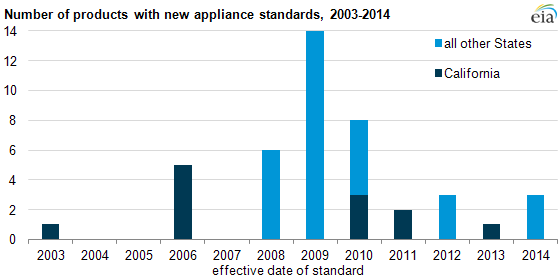
In many cases, California has been the first State to issue an appliance state-level efficiency standard. Often other States may follow suit. With enough market transformation, Congress or DOE may establish a national standard that avoids the potential patchwork of several States' standards.
Televisions serve as a good example: in 2009, California adopted a standard that would take effect in 2011. Then last year Connecticut adopted a similar standard effective 2014. Meanwhile, DOE is currently engaged in creating the test procedure for televisions, soliciting input from efficiency advocates, manufacturers, and the general public. Test procedures measure the energy efficiency characteristics of products and must be completed before any potential standard analysis.
Not all standards happen quickly, though. In much of the last decade, DOE fell behind their Congressionally-legislated schedule. Recently, DOE has made progress working through this backlog of rulemakings. Last year, for the first time, DOE made two new product coverage determinations to add set-top boxes (digital video recorders) and network equipment, as well as commercial/industrial fans, blowers, and fume hoods to the list of products for which Federal efficiency standards will be set.