
Beaumont refinery expansion boosts Gulf Coast petroleum refining capacity
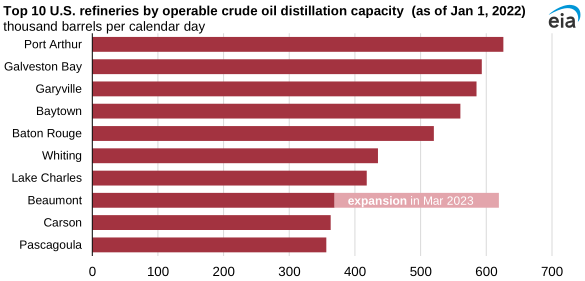
On March 16, ExxonMobil announced the beginning of operations at the expansion of its Beaumont refinery, adding 250,000 barrels per day (b/d) of capacity, according to the company’s announcement. The expansion makes the oil refinery one of the largest in the United States as measured by crude oil distillation capacity. According to ExxonMobil, the total capacity of the Beaumont facility is now 630,000 b/d.
The Beaumont expansion is the first major refinery capacity expansion to come online since the COVID-19 pandemic, which caused several refinery capacity closures over the course of 2020 and 2021. U.S. refinery distillation capacity decreased from 19.0 million b/d at the start of 2020 to 17.9 million b/d at the start of 2022. In June, we expect to update our Refinery Capacity Report with information about refinery capacity at the start of 2023. That report will not include the Beaumont capacity addition because it was not operational at the start of 2023.
Beaumont’s added capacity is the largest of a cluster of new capacity expected to come online in 2023 and 2024, much of it concentrated on the U.S. Gulf Coast. The region has historically been the largest refining hub in the United States and accounts for 8 of the 10 largest refineries in the country. New refinery capacity in the region capitalizes on growing U.S. crude oil production. The region also benefits from existing infrastructure for shipping refined products to the East Coast, to Mexico (the largest destination for U.S. gasoline exports), and to other destinations by way of available coastal tanker loading facilities.
Increased refinery capacity and, as a result, increased gasoline and diesel production should reduce fuel prices this summer compared with 2022. At the same time, more refinery production may be offset, at least in part, by a combination of higher crude oil prices, increasing consumption, and low fuel inventories.
Global refinery capacity also decreased during 2020 and 2021, which drew down global inventories and increased calls on U.S. exporters to meet consumption needs in other markets. Other international refinery capacity additions have been coming online or are expected to come online later this year as well, particularly in the Middle East, Nigeria, India, and China. These expansions will likely increase global supply of refined products and lower crack spreads.
Principal contributor: Kevin Hack
Tags: Gulf Coast, liquid fuels, crude oil, oil/petroleum, refineries