
U.S. refinery capacity decreased during 2021 for second consecutive year
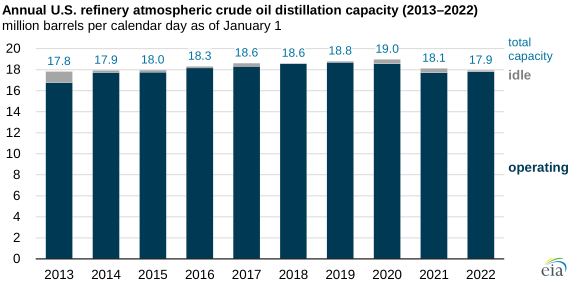
Operable atmospheric crude oil distillation capacity, our primary measure of refinery capacity in the United States, totaled 17.9 million barrels per calendar day as of January 1, 2022, down 1% from the beginning of 2021. According to our annual Refinery Capacity Report, 2021 was the second consecutive year of decreasing refinery capacity.
We publish two measures of U.S. refinery capacity: barrels per calendar day (b/cd) and barrels per stream day (b/sd). Calendar-day capacity represents the operator’s estimate of the input that a distillation unit can process over a 24-hour period under usual operating conditions, taking into account the effects of both planned and unplanned maintenance.
Stream-day capacity reflects the maximum input that a distillation facility can process within a 24-hour period when running at full capacity with an optimal crude oil and product slate and with no allowance for downtime. Stream-day capacity is typically about 6% higher than calendar-day capacity.
Although U.S. refining capacity decreased in 2021, the number of operable refineries in the United States increased from 129 refineries to 130 refineries. Two new facilities came online in 2021, but a much larger refinery shut down. The new facilities are the Texas International Terminals facility in Galveston, Texas, where a 45,000 b/cd atmospheric distillation unit was built at a refined products terminal, and the Talley Asphalt Products facility in Kern, California, where a 1,700 b/cd distillation unit was reported as part of an asphalt plant.
The Phillips 66 refinery in Belle Chasse, Louisiana, (also called the Alliance refinery) stopped refining operations following substantial flooding related to Hurricane Ida in late 2021. This refinery had an operating capacity of 255,600 b/cd.
Because the 2022 Refinery Capacity Report reflects conditions as of the beginning of the year, it does not incorporate a few reductions in U.S. refining capacity announced later in 2022. In April 2022, LyondellBasell announced that its 263,800 b/cd refinery in Houston will close by the end of 2023. In May 2022, Phillips 66 announced plans to stop refining petroleum at its 120,200 b/cd Rodeo refinery in California while the facility transitions to refining biofuels.
Principal contributors: Kevin Hack, Julie Harris