
Iraq’s oil production has nearly doubled over the past decade
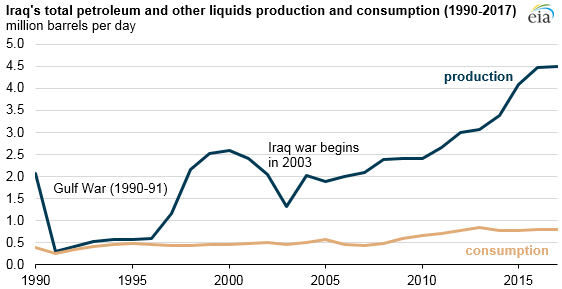
Crude oil production in Iraq averaged 4.5 million barrels per day (b/d) through August 2018, up from 4.4 million b/d in 2017. Iraq’s crude oil production has been steadily increasing since declines in the late 1990s and early 2000s, and it has nearly doubled over the past decade.
Iraq is the second-largest crude oil producer in the Organization of the Petroleum Exporting Countries (OPEC), after Saudi Arabia, and holds the world’s fifth-largest proved crude oil reserves. Nearly 90% of Iraq’s crude oil production comes from onshore oil fields in the southern part of the country; these fields are under the control of the central government in Baghdad.
The remaining 10% of Iraqi crude oil production comes from oil fields in northern Iraq, mostly operated by the Kurdistan Regional Government (KRG). Disputes between the Iraqi central government and KRG have resulted in disruptions to production in the region, but current production has partially recovered as of mid-2018.
Iraqi consumption of petroleum and other liquids has also been increasing over the past decade, and consumption reached 0.8 million b/d of petroleum and other liquids in 2017. Iraq relies on imports of some petroleum products—including diesel, gasoline, and kerosene—but much of the country’s petroleum and other liquids consumption is met by domestic production.
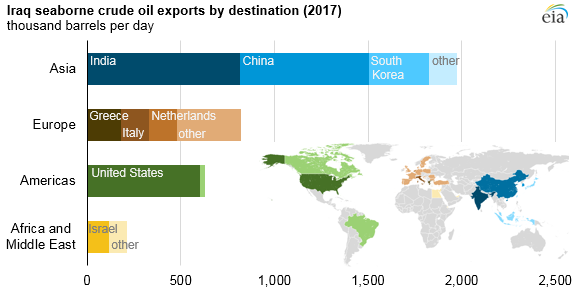
Iraq produces significantly more oil than it consumes and exports the remainder. Total seaborne Iraqi crude oil exports averaged 3.8 million b/d in 2017, mostly from terminals in southern Iraq. More than half of Iraqi seaborne exports go to markets in Asia. Exports to the United States account for 17% of total Iraqi exports. Relatively small volumes of crude oil are also transported by truck or pipeline to Turkey. Iraq’s economy is heavily dependent on crude oil export revenues. Crude oil exports accounted for 88%, or almost $60 billion of total government revenues in 2017, excluding those from the KRG.
More information on Iraq’s energy industry can be found in EIA’s recently updated Country Analysis Brief on Iraq.
Principal contributors: Michael Mobilia, Lejla Villar