
Natural gas storage ends winter heating season at record high
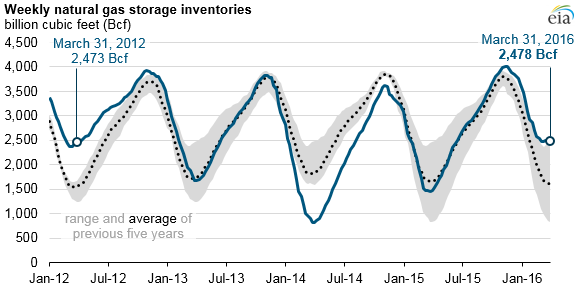
Working natural gas inventories ended the winter heating season at 2,478 billion cubic feet (Bcf), exceeding the previous end-of-March record high of 2,473 Bcf, set in 2012, according to EIA's Weekly Natural Gas Storage Report. Inventory withdrawals during the traditional heating season (November through March) were relatively limited this year because of winter weather that was the warmest on record and continued high levels of domestic natural gas production.
Heading into the winter heating season, inventories were at a record high of 4,009 Bcf on November 20, 2015. In the previous five winters, the total withdrawal from the end of October through the end of March averaged 2,176 Bcf. In the most recent winter, weekly withdrawals were often smaller than the five-year average level, and the total withdrawal was only 1,475 Bcf.
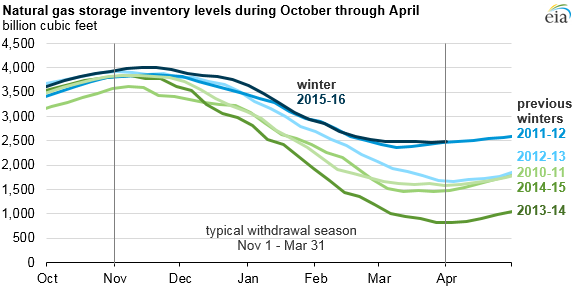
EIA expects the summer build in working natural gas inventories will total about 1,600 Bcf. This amount would be a relatively small summer build, as injections are expected to be limited by available storage capacity. Recent data show that natural gas storage facilities in most regions of the United States already are at 44%-73% of their design capacity. The forecast build puts inventories at the end of October at a record high.
EIA's Short-Term Energy Outlook (STEO) expects that this summer could be similar to the summer of 2012 in terms of natural gas storage and its impact on natural gas prices and consumption. In 2012, following a warm winter, end-of-March inventories were at record-high levels. Low natural gas prices at the time and high production levels led to record-high consumption of natural gas in the electric power sector, both for the summer and the year as a whole. In 2015, natural gas use by electric power generators broke the 2012 record, and STEO projects another record will be set for 2016. Although this month's STEO expects a slowdown in natural gas production growth in 2016, domestic supplies still remain at high levels.
Principal contributor: Katie Teller
Tags: inventories/stocks, natural gas, storage