U.S. Energy Information Administration logo
Skip to sub-navigation
February 19, 2015

Wind generates more than 10% of Texas electricity in 2014
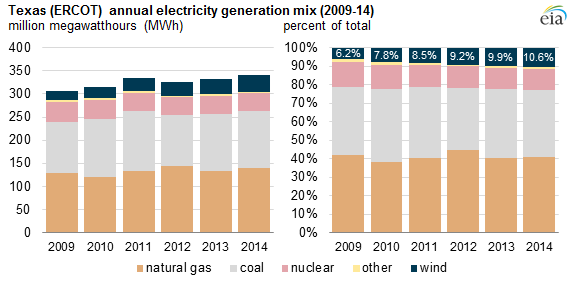
graph of Texas (ERCOT) annual electricity generation mix, as explained in the article text
Source: U.S. Energy Information Administration, based on the Electric Reliability Council of Texas (ERCOT)

In 2014, more than 10% of the electricity used in the grid covering most of Texas came from wind generation, according to the grid's operator, the Electric Reliability Council of Texas (ERCOT). Wind's share of the ERCOT generation mix grew from 6.2% in 2009 to 10.6% in 2014 as total electricity generation increased over the same period by 11.3%. The growth in wind generation is a result of new wind plants coming online and grid expansions that have allowed more wind power to flow through the system to consumers.
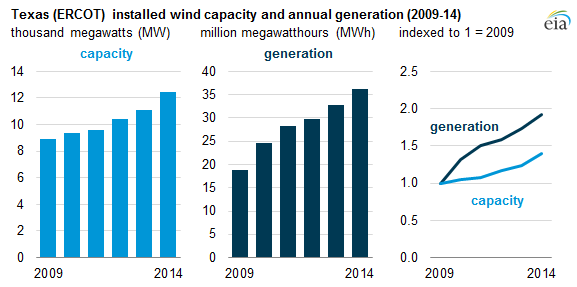
graph of Texas (ERCOT) installed wind capacity and annual generation, as explained in the article text
Source: U.S. Energy Information Administration, based on the Electric Reliability Council of Texas (ERCOT)

Wind generation in ERCOT nearly doubled from 18.8 million megawatthours (MWh) in 2009 to 36.1 million MWh in 2014. Wind capacity has also grown substantially over the past six years (and much more so in the years before that), but wind generation grew at a faster pace, partly because transmission constraints that previously prevented wind generators from operating at their maximum capability were gradually removed through a state-directed transmission expansion program. As these transmission constraints were removed, more generation from wind plants (largely concentrated in the northwestern part of the state) could reach the state's population centers. The result has been a faster increase in wind generation than in wind capacity from 2009 to 2014.
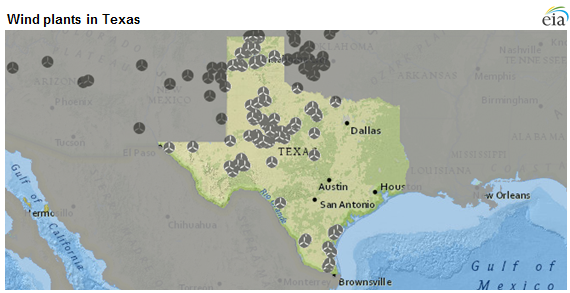
map of wind plants in Texas, as explained in the article text
Source: U.S. Energy Information Administration, U.S. Energy Mapping System
Note: Wind plants shown are facilities with a net summer capacity of 1 MW and above. Wind plants shown also include those located in the small areas of Texas lying outside the ERCOT grid footprint.

Wind's contribution to ERCOT generation is not evenly distributed throughout the year. In Texas, peak wind season occurs during the spring—March to June—before significantly dropping off during the summer—July to September. Based on data for the past six years, the four months from March through June account for on average about 40% of annual wind generation in ERCOT. The graph on the right below shows a fairly consistent seasonal pattern from year to year, despite the difference in actual volumes of generation.
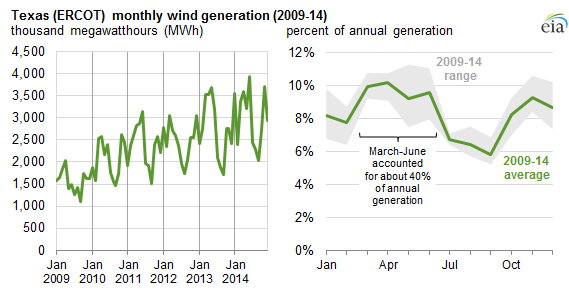
graph of Texas (ERCOT) monthly wind generation, as explained in the article text
Source: U.S. Energy Information Administration, based on the Electric Reliability Council of Texas (ERCOT)

Principal contributor: April Lee

Statistics
Analysis
Tools
Education
News

Petroleum & Other Liquids

Crude oil, gasoline, heating oil, diesel, propane, and other liquids including biofuels and natural gas liquids.

Natural Gas

Exploration and reserves, storage, imports and exports, production, prices, sales.

Electricity

Sales, revenue and prices, power plants, fuel use, stocks, generation, trade, demand & emissions.

Coal

Reserves, production, prices, employment and productivity, distribution, stocks, imports and exports.

Nuclear & Uranium

Uranium fuel, nuclear reactors, generation, spent fuel.

Renewable & Alternative Fuels

Includes hydropower, solar, wind, geothermal, biomass and ethanol.

EIA Survey Forms

Forms EIA uses to collect energy data including descriptions, links to survey instructions, and additional information.

Total Energy

Comprehensive data summaries, comparisons, analysis, and projections integrated across all energy sources.

U.S. States

State energy information, including overviews, rankings, data, and analyses.

International

International energy information, including overviews, rankings, data, and analyses.

Environment

Greenhouse gas data, voluntary reporting, electric power plant emissions.

Data Tools, Apps, & Maps

Tools to customize searches, view specific data sets, study detailed documentation, and access time-series data.

Open Data

EIA's free and open data available as API, Excel add-in, bulk files, and widgets

EIA Beta

Come test out some of the products still in development and let us know what you think!

Open Source Code

EIA's open source code, available on GitHub.

RSS Feeds

Subscribe to feeds for updates on EIA products including Today in Energy and What's New.