U.S. Energy Information Administration logo
Skip to sub-navigation
July 25, 2013

EIA projects world energy consumption will increase 56% by 2040
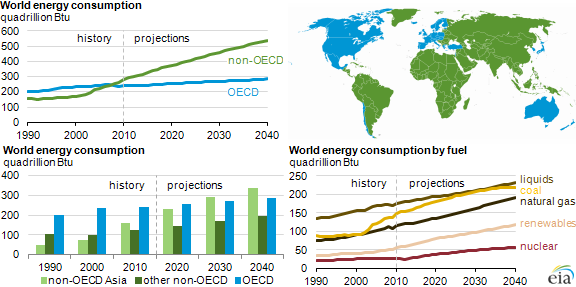
Graph of global energy consumption, as explained in the article text
Source: U.S. Energy Information Administration, International Energy Outlook 2013.

EIA's recently released International Energy Outlook 2013 (IEO2013) projects that world energy consumption will grow by 56% between 2010 and 2040, from 524 quadrillion British thermal units (Btu) to 820 quadrillion Btu. Most of this growth will come from non-OECD (non-Organization for Economic Cooperation and Development) countries, where demand is driven by strong economic growth.

Renewable energy and nuclear power are the world's fastest-growing energy sources, each increasing 2.5% per year. However, fossil fuels continue to supply nearly 80% of world energy use through 2040. Natural gas is the fastest-growing fossil fuel, as global supplies of tight gas, shale gas, and coalbed methane increase.

The industrial sector continues to account for the largest share of delivered energy consumption and is projected to consume more than half of global delivered energy in 2040. Based on current policies and regulations governing fossil fuel use, global energy-related carbon dioxide emissions are projected to rise to 45 billion metric tons in 2040, a 46% increase from 2010. Economic growth in developing nations, fueled by a continued reliance on fossil fuels, accounts for most of the emissions increases.

See the full IEO2013 for discussion on many other topics including

  • Effects of recovery from the global economic recession
  • Additions in net electricity generation
  • Rising global natural gas production
  • Trends in global liquid fuels production and use
  • Higher coal consumption in the near term
Statistics
Analysis
Tools
Education
News

Petroleum & Other Liquids

Crude oil, gasoline, heating oil, diesel, propane, and other liquids including biofuels and natural gas liquids.

Natural Gas

Exploration and reserves, storage, imports and exports, production, prices, sales.

Electricity

Sales, revenue and prices, power plants, fuel use, stocks, generation, trade, demand & emissions.

Coal

Reserves, production, prices, employment and productivity, distribution, stocks, imports and exports.

Nuclear & Uranium

Uranium fuel, nuclear reactors, generation, spent fuel.

Renewable & Alternative Fuels

Includes hydropower, solar, wind, geothermal, biomass and ethanol.

EIA Survey Forms

Forms EIA uses to collect energy data including descriptions, links to survey instructions, and additional information.

Total Energy

Comprehensive data summaries, comparisons, analysis, and projections integrated across all energy sources.

U.S. States

State energy information, including overviews, rankings, data, and analyses.

International

International energy information, including overviews, rankings, data, and analyses.

Environment

Greenhouse gas data, voluntary reporting, electric power plant emissions.

Data Tools, Apps, & Maps

Tools to customize searches, view specific data sets, study detailed documentation, and access time-series data.

Open Data

EIA's free and open data available as API, Excel add-in, bulk files, and widgets

EIA Beta

Come test out some of the products still in development and let us know what you think!

Open Source Code

EIA's open source code, available on GitHub.

RSS Feeds

Subscribe to feeds for updates on EIA products including Today in Energy and What's New.