
Most U.S. utility-scale solar photovoltaic power plants are 5 megawatts or smaller
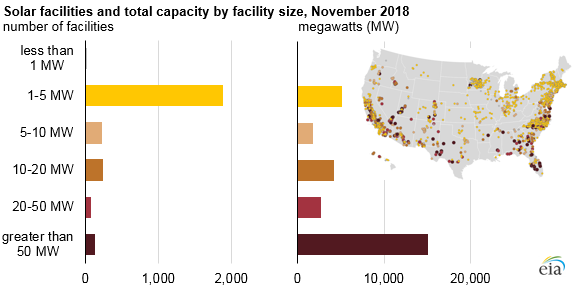
The United States has more than 2,500 utility-scale solar photovoltaic (PV) electricity generating facilities. Most of these power plants are relatively small and collectively account for 2.5% of utility-scale electric generating capacity and 1.7% of annual electricity generation, based on data through November 2018.
EIA considers utility-scale generating facilities to be those where total generation capacity is one megawatt (MW) or greater. However, some utility-scale sites use more than one generating technology. At utility-scale facilities where PV is one of several technologies in use, the PV capacity itself may be less than one megawatt, but this is relatively rare: based on EIA’s latest data, only 20 sites with a total combined capacity of 10 MW were in this category.
The growth in small utility-scale facilities is driven by several factors, many of which are tied to state-level policies and practices. For example, North Carolina used the Public Utilities Regulatory Policies Act of 1978 to allow utilities to set long-term purchase agreements with solar facilities, enabling solar developers to secure project funding more easily and spurring growth.
Currently, North Carolina has 433 utility-scale PV facilities with capacities no greater than 5 MW, the most of any state, and accounting for nearly a quarter of all utility-scale PV facilities in the country between 1 MW and 5 MW. These facilities collectively account for 1,803 MW of capacity, or 35% of the total U.S. PV capacity located at facilities with 1 MW to 5 MW of installed capacity.
In other states, the growth of small utility-scale PV capacity is encouraged by strategies that include, for example, community solar facilities. Community solar facilities offer a share of their solar capacity for sale to off-site customers who may not necessarily have access to solar generation. In these programs, customers may subscribe to a designated community solar facility and receive monthly credits on their electric bills for the energy generated by the share of solar capacity they purchase. The average community solar facility has a capacity of 2.0 MW.
Growth in small utility-scale facilities is expected to continue through 2020. EIA’s Preliminary Monthly Electric Generator Inventory for October 2018 reports that most of the 216 solar PV facilities that will come online by the end of 2020 will have capacities of five megawatts or less.
Solar PV facilities with less than one megawatt in capacity are not included in EIA’s surveys of electricity generators, but their aggregate capacities are included in the EIA’s survey of electric power sales, revenue, and energy efficiency and are represented in EIA’s Electric Power Monthly. EIA estimates small-scale solar PV capacity to be about 40% of total solar capacity connected to the grid as of November 2018.
Principal contributor: Alex Mey
Tags: generation, electricity, power plants, solar