U.S. Energy Information Administration logo
Skip to sub-navigation
February 12, 2013

Newer U.S. homes are 30% larger but consume about as much energy as older homes
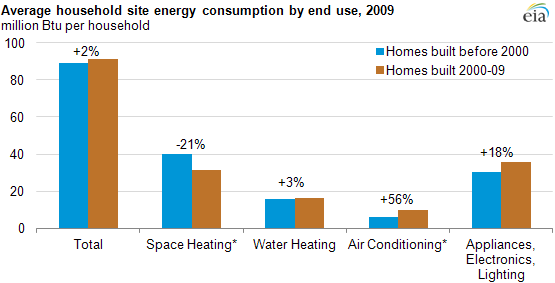
Graph of average household site energy consumption, as explained in the article text
Source: U.S. Energy Information Administration, Residential Energy Consumption Survey.
*Note: Averages for space heating and air conditioning reflect only those households that heated or cooled their homes in 2009.

Analysis from EIA's most recent Residential Energy Consumption Survey (RECS) shows that U.S. homes built in 2000 and later consume only 2% more energy on average than homes built prior to 2000, despite being on average 30% larger.

Homes built in the 2000s accounted for about 14% of all occupied housing units in 2009. These new homes consumed 21% less energy for space heating on average than older homes (see graph), which is mainly because of increased efficiency in the form of heating equipment and better building shells built to more demanding energy codes. Geography has played a role too. About 53% of newer homes are in the more temperate South, compared with only 35% of older homes.

The increase in energy for air conditioning also reflects this population migration as well as higher use of central air conditioning and increased square footage. Similar to space heating, these gains were likely moderated by increases in efficiency of cooling equipment and improved building shells, but air conditioning was not the only end use that was higher in newer homes. RECS data show that newer homes were more likely than older homes to have dishwashers, clothes washers, clothes dryers, and two or more refrigerators. Newer homes, with their larger square footage, have more computers, TVs, and TV peripherals such as digital video recorders (DVRs) and video game systems. In total, newer homes consumed about 18% more energy on average in 2009 for appliances, electronics, and lighting than older homes.
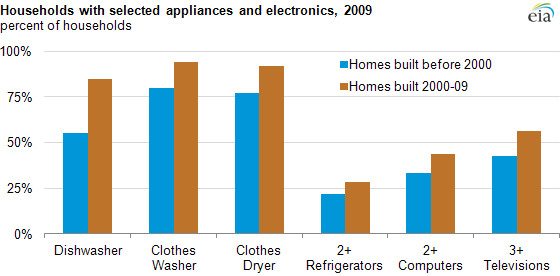
Graph of appliance use by household, as explained in the article text
Source: U.S. Energy Information Administration, Residential Energy Consumption Survey.

Statistics
Analysis
Tools
Education
News

Petroleum & Other Liquids

Crude oil, gasoline, heating oil, diesel, propane, and other liquids including biofuels and natural gas liquids.

Natural Gas

Exploration and reserves, storage, imports and exports, production, prices, sales.

Electricity

Sales, revenue and prices, power plants, fuel use, stocks, generation, trade, demand & emissions.

Coal

Reserves, production, prices, employment and productivity, distribution, stocks, imports and exports.

Nuclear & Uranium

Uranium fuel, nuclear reactors, generation, spent fuel.

Renewable & Alternative Fuels

Includes hydropower, solar, wind, geothermal, biomass and ethanol.

EIA Survey Forms

Forms EIA uses to collect energy data including descriptions, links to survey instructions, and additional information.

Total Energy

Comprehensive data summaries, comparisons, analysis, and projections integrated across all energy sources.

U.S. States

State energy information, including overviews, rankings, data, and analyses.

International

International energy information, including overviews, rankings, data, and analyses.

Environment

Greenhouse gas data, voluntary reporting, electric power plant emissions.

Data Tools, Apps, & Maps

Tools to customize searches, view specific data sets, study detailed documentation, and access time-series data.

Open Data

EIA's free and open data available as API, Excel add-in, bulk files, and widgets

EIA Beta

Come test out some of the products still in development and let us know what you think!

Open Source Code

EIA's open source code, available on GitHub.

RSS Feeds

Subscribe to feeds for updates on EIA products including Today in Energy and What's New.