
Natural gas processing plant data now available
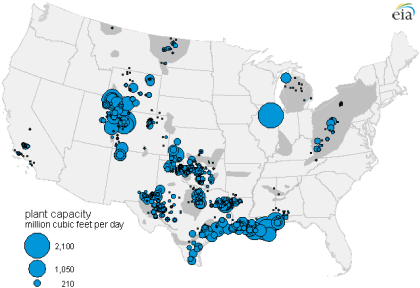
Note: Gray-shaded areas represent current U.S. shale plays.
In the wake of Hurricane Katrina in 2005, which severely disrupted natural gas infrastructure in the Gulf Coast region, EIA established a triennial survey of natural gas processing plants (EIA-757) to be used as a baseline for assessing the effect of extreme weather on natural gas processing infrastructure. This past summer, EIA activated the baseline survey (EIA-757, Schedule A), the results of which are published in EIA's Natural Gas Annual Respondent Query System.
The EIA-757 survey has a baseline portion, Schedule A, to track the country's population of natural gas plants, and an emergency activation portion, Schedule B, to provide the operational status of processing plants in an area affected by a supply disruption, usually a natural disaster such as a hurricane. In August, EIA activated Schedule B to track shut-in capacity caused by Hurricane Isaac. EIA used the information collected on EIA-757B to provide daily updates to the Department of Energy's Situation Report and to write a brief retrospective for Today in Energy.
Data from EIA-757 Schedule A show 517 active natural gas processing plants in the Lower 48 states, with a total processing capacity of 65.5 billion cubic feet per day. Not all processing plants run at full capacity all the time. On average, these plants processed about 44.7 billion cubic feet per day, operating at about 68% of capacity. Plants operate at less than capacity for many reasons: transportation constraints, varying input supplied from wells, and regional economics.
Processing plants are midstream facilities that separate natural gas liquids (NGL) from natural gas. Gas processing plants often perform several other functions, as well: dehydration, contaminant removal, and sometimes fractionation (separating an NGL stream into its component products). This survey is not a complete picture of processing capabilities, nor does it represent all processing plants that touch natural gas before it becomes pipeline-quality gas. At the well site, some upstream field processing may be done to remove condensate before gas is sent to a midstream processing plant for NGL extraction. In addition, gas producers may use dehydration units (to remove water) and amine treaters (to remove hydrogen sulfide and carbon dioxide).
Downstream from natural gas processing plants, the combined NGL stream is often broken into separate NGL products (ethane, propane, butane, iso-butane, pentane) by a fractionator. Sometimes straddle plants located on large pipelines will extract small quantities of NGL that remain in the stream even after processing. Similarly, newer, more efficient cryogenic plants may also sit downstream of other processing plants to strip out lighter NGLs that are left in the gas stream for technological or economic reasons. Most storage facilities also have some processing capabilities to dehydrate gas that is withdrawn from storage. When pipeline-quality natural gas is injected into storage, it mingles with other hydrocarbons or water, which must be removed before the gas can be reintroduced into the pipeline grid.