
Territorial disputes hamper exploration and production of resources in the East China Sea
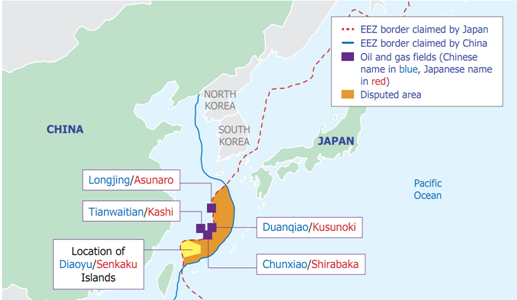
Note: Exclusive Economic Zone (EEZ).
The East China Sea may have abundant hydrocarbon resources, especially natural gas, although the region is underexplored. China and Japan, the two largest energy consumers in Asia, are both interested in using natural gas from the East China Sea to meet rising domestic demand. However, unresolved territorial disputes make exploration and development of these resources difficult.
China is the world's largest energy consumer and the second largest importer of oil after the United States. Because of its growing reliance on natural gas in recent years, China is now a net importer of natural gas. EIA forecasts continued growth in Chinese oil and natural gas consumption, necessitating new supplies to meet demand.
Japan is the world's third largest net importer of crude oil, and the world's largest importer of liquefied natural gas. Japan is expected to continue to rely heavily on imports to meet future consumption needs.
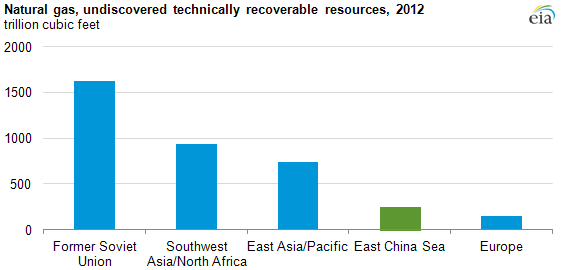
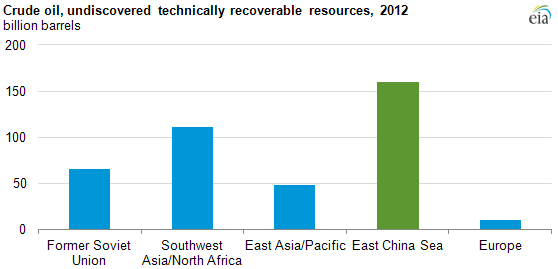
Hydrocarbon reserves in the East China Sea are difficult to estimate, but EIA estimates the East China Sea contains 60-100 million barrels of oil in proven and probable reserves, and 1-2 trillion cubic feet (Tcf) of proven and probable natural gas reserves. Estimates of undiscovered resources, which do not take into account economic and technological factors relevant to bringing them into production, show significant resource potential. Chinese sources estimate as much as 70-160 billion barrels of oil and 250 Tcf of natural gas in undiscovered, technically recoverable resources.
Chinese authorities seek to increase offshore natural gas production to supply Shanghai and nearby cities. However, the East China Sea is not expected to become a significant supplier of oil for a number of years, even after resolution of the territorial disputes.
China and Japan have two separate territorial disputes in the East China Sea: where to demarcate the sea boundary between each country and how to assign sovereignty over a group of islands called Diaoyu by the Chinese and Senkaku by the Japanese. The two countries have held bilateral talks, as well as considered joint development of resources in the Sea, with no agreement thus far.
Further exploration and development in this region may be hampered until these disputes are resolved. For more information on the East China Sea, read EIA's regional analysis brief.