U.S. Energy Information Administration logo
Skip to sub-navigation
June 22, 2012

Significant potential for plug-in vehicles exists in U.S. housing stock
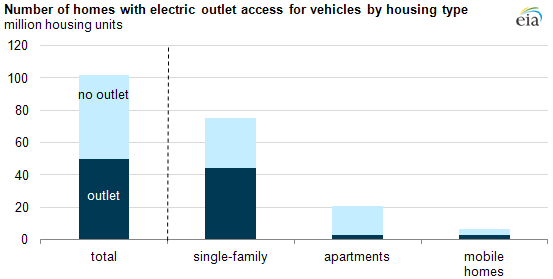
graph of Number of homes with electric outlet access by housing type, as described in the article text
Source: U.S. Energy Information Administration, Residential Energy Consumption Survey.
Note: Excludes the 11.2 million households without a vehicle.

The housing stock in the United States could support significant numbers of plug-in electric vehicles. Of households that own at least one car, an estimated 49% (49.6 million housing units) park within 20 feet of an electrical outlet, based on recently released responses to a new question from the 2009 Residential Energy Consumption Survey (RECS).

Certain housing characteristics limit potential for electric (either plug-in hybrid or all-electric) vehicles, especially the type of housing. Excluding households without cars and those where the respondent did not know whether an electrical outlet was accessible, 60% of respondents in single-family detached houses park within 20 feet of an outlet, as opposed to only 14% of respondents in apartments. Most electric vehicles can be charged using the same outlet as a home appliance.  However, some electric vehicle manufacturers recommend installing a separate charger that can charge the vehicle faster.

Housing stock in some regions is better suited to support electric vehicles. In the Northeast Census region, less than 40% of all respondents in single-family houses park their car within 20 feet of an electrical outlet. In contrast, for single-family houses in the Midwest region, more than 60% of respondents park their car within 20 feet of an electrical outlet.

Newer houses tend to provide better access to electrical outlets. Differences based on the age of the housing unit exist, but the major increase in outlet access did not occur until the 1990s. Income and location in an urban area also influence accessibility of outlets for charging vehicles. About 65% of respondents from single-family detached housing units with incomes greater than $80,000 per year park with access to an electrical outlet (see chart below). Only 47% of respondents from urban areas have access compared to 55% from rural areas, reflecting the prevalence of apartments in the urban housing stock.
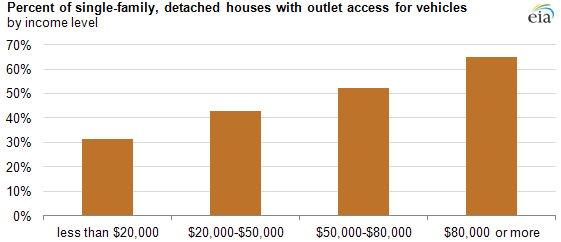
graph of Percentage of single-family detached houses with outlet access by income level, as described in the article text
Source: U.S. Energy Information Administration, Residential Energy Consumption Survey.
Note: Excludes the 11.2 million households without a vehicle.

Statistics
Analysis
Tools
Education
News

Petroleum & Other Liquids

Crude oil, gasoline, heating oil, diesel, propane, and other liquids including biofuels and natural gas liquids.

Natural Gas

Exploration and reserves, storage, imports and exports, production, prices, sales.

Electricity

Sales, revenue and prices, power plants, fuel use, stocks, generation, trade, demand & emissions.

Coal

Reserves, production, prices, employment and productivity, distribution, stocks, imports and exports.

Nuclear & Uranium

Uranium fuel, nuclear reactors, generation, spent fuel.

Renewable & Alternative Fuels

Includes hydropower, solar, wind, geothermal, biomass and ethanol.

EIA Survey Forms

Forms EIA uses to collect energy data including descriptions, links to survey instructions, and additional information.

Total Energy

Comprehensive data summaries, comparisons, analysis, and projections integrated across all energy sources.

U.S. States

State energy information, including overviews, rankings, data, and analyses.

International

International energy information, including overviews, rankings, data, and analyses.

Environment

Greenhouse gas data, voluntary reporting, electric power plant emissions.

Data Tools, Apps, & Maps

Tools to customize searches, view specific data sets, study detailed documentation, and access time-series data.

Open Data

EIA's free and open data available as API, Excel add-in, bulk files, and widgets

EIA Beta

Come test out some of the products still in development and let us know what you think!

Open Source Code

EIA's open source code, available on GitHub.

RSS Feeds

Subscribe to feeds for updates on EIA products including Today in Energy and What's New.