
Reasons behind the price premium for U.S. metallurgical coal exports
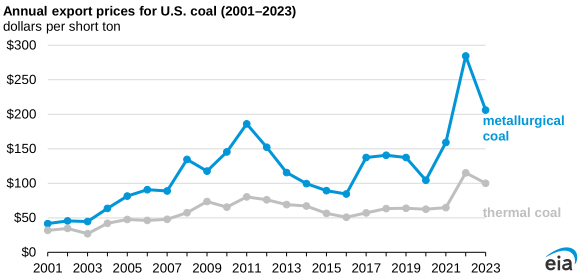
U.S. coal used for the steelmaking process has sold for more than double the price of U.S. coal used as a fuel for electricity generation in six of the last seven years, underscoring a historical trend. U.S. metallurgical coal, used primarily as a raw material in the steelmaking process, historically has sold into export markets at prices higher than those for U.S. thermal coal, a major fuel for electricity generation. From 2001 to 2023, U.S. metallurgical coal sold at an average premium of 90% to the price of thermal coal.
The average price for U.S. metallurgical coal exports rose particularly sharply in 2022 following trade restrictions on coal from Russia—one of the few other major metallurgical coal producers—implemented in the wake of Russia’s full-scale invasion of Ukraine combined with global supply chain disruptions during the same year.
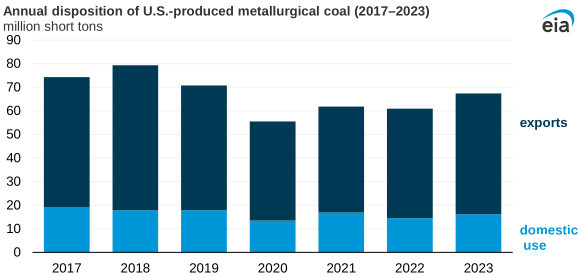
This sustained price divergence illustrates differences in the two major markets served by the U.S. coal industry. Metallurgical coal accounts for approximately 10% of U.S coal output, and nearly all of it is exported. Thermal coal produced in the United States, by contrast, mostly is consumed domestically. Of the estimated 67 million short tons of metallurgical coal produced in the United States in 2023, 76% (51 million short tons) was exported to coke producers and steelmakers around the world, data from our Annual Coal Report and Quarterly Coal Report show. In contrast, the amount of thermal coal exported rarely exceeds 8% of its annual production.
The higher prices for metallurgical coal stem from its unique quality and uses. Metallurgical coal is a low-ash, low-sulfur bituminous coal used in the blast furnace steel manufacturing process once it has been converted into coke. Coke is a strong, dense, and nearly pure carbon residual product that serves as a fuel and reductant when mixed with iron ore and limestone in a blast furnace to produce pig iron. In the final part of the integrated steelmaking process, pig iron is converted into steel by adding oxygen.
Although production of steel using pig iron blast furnaces is only 30% of raw steel production in the United States, its share of global steel output is approximately 70%. U.S. metallurgical coal is in high demand from international pig iron blast furnace steel producers.
In addition, fewer competing producers take part in the metallurgical coal market than in the thermal coal market. Only three other countries—Australia, Canada, and Russia—have the reserves necessary to produce and export substantial amounts of metallurgical coal of similar quality as the United States. China produces more than half of the world’s metallurgical coal, but it is all consumed domestically. Australia is the largest exporter of metallurgical coal, followed by the United States, Russia, and Canada.
Metallurgical coal also differs fundamentally from thermal coal because it is more expensive to produce. Metallurgical coal reserves in the United States are found almost exclusively in the Appalachia region, where mining primarily occurs in underground operations. The cost of mining metallurgical coal typically exceeds that of producing thermal coal because the majority of metallurgical coal is mined from thinner seams. Mining operations must use lower-capacity mining equipment and require more manpower. Also, most metallurgical coal must be treated to rid the coal of ash and sulfur impurities, resulting in lower yields. Although mining costs are higher for metallurgical coal, the higher export price more than offsets the higher cost.
Principal contributors: Jonathan Church, Mark Morey
Tags: coal, prices, exports/imports