
NERC assessment highlights potential electricity reliability concern for central U.S.
Higher electricity demand forecasts and potential supply reductions are raising concerns about tight reserve margins in the Midcontinent Independent System Operator (MISO) balancing authority this summer. Working in conjunction with regional utility service providers, balancing authorities are responsible for ensuring that wholesale electric power markets provide sufficient electric generation capacity to meet consumer demand, both in real time and over several years.
To ensure reliability, balancing authorities plan for more supply than demand. The difference between supply and demand is called a reserve margin—a metric tracked closely by balancing authorities and reliability planners. MISO, as the balancing authority spanning 15 states in the central United States, conducts seasonal assessments for market participants and stakeholders to help ensure the reliable operation of its member utilities’ service area.
The North American Electric Reliability Corporation (NERC) compiled expectations of summer supply and demand conditions in its 2022 Summer Reliability Assessment, including reserve margins for grid regions. NERC is a non-profit regulatory authority that supports the reliability of the electric grid through regional reliability entities that are in turn made up of individual or groups of balancing authority areas. NERC publishes seasonal reliability assessments for the United States and Canada each summer and winter.
MISO’s anticipated reserve margin this summer is 21.1%, meaning available resources are higher than expected demand, but a combination of higher-than-forecast demand or lower-than-expected supply availability could reduce that margin, leading to reliability concerns.
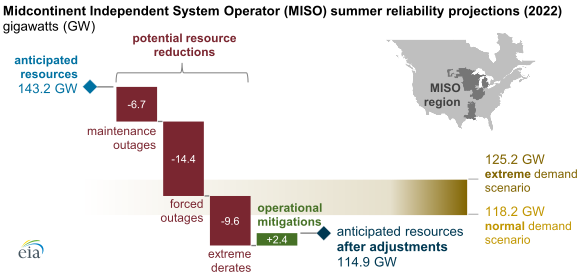
To anticipate electricity demand, MISO produces a range of forecasts, including a forecast of average yearly demand and a forecast of extreme conditions that would occur only once in 10 years. Based on these assumptions, MISO expects that hourly electricity demand could reach 118.2 gigawatts (GW) in normal conditions and 125.2 GW in extreme conditions. These values assume that the available demand response measures to lower electricity demand have already been deployed.
On the supply side, MISO expects to have 143.2 GW of available capacity this summer. However, planned maintenance and forced outages could reduce the available capacity. In the past five years, MISO has had an average of 6.7 GW of maintenance outages and 14.4 GW of forced outages in the summer.
Seasonal derates—which include factors such as drought, low-wind conditions, or fuel supply limitations—have further reduced MISO’s summer electricity supply by as much as 9.6 GW in the past five years. To counter some of these outages and derates, MISO has identified 2.4 GW of capacity it can call on during emergency conditions, which are labeled operational mitigations in the NERC report. Accounting for these reductions and mitigations, MISO’s anticipated resources could total 114.9 GW, or less supply than its normal demand expectation.
Concerns about long-run capacity shortfalls have prompted MISO to outline measures it will take in response to changes in the electric generator fleet, extreme weather events, and other challenges. In addition, MISO holds forward capacity auctions to provide revenue to generators that commit to being available in future periods. The most recent auction showed a risk of insufficient capacity in most regions due to the continued retirement of electric generating capacity.
Principal contributor: M. Tyson Brown