
EIA expects U.S. petroleum trade to shift toward net imports during 2022
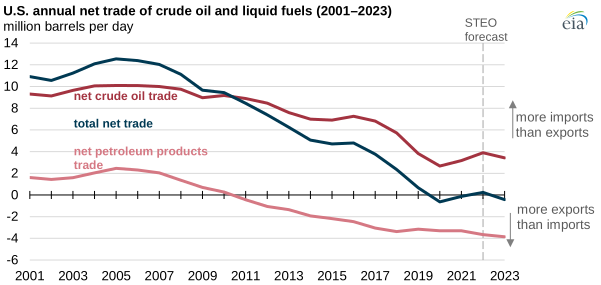
Following its historic shift to being a net exporter of petroleum in 2020, the United States continued to export more petroleum (which includes crude oil, refined petroleum products, and other liquids) than it imported in 2021. According to our February 2022 Short-Term Energy Outlook (STEO), we expect net crude oil imports to increase, making the United States a net importer of petroleum in 2022.
A country is a net importer if it imports more of a commodity than it exports. Conversely, a country is a net exporter if it exports more of a commodity than it imports. Many factors affect net trade numbers because trade reflects supply and demand conditions both domestically and internationally.
Historically, the United States has been a net importer of petroleum. During 2020, COVID-19 mitigation efforts caused a drop in oil demand within the United States and internationally. International petroleum prices decreased in response to less consumption, which diminished incentives for key petroleum-exporting countries to increase production. This shift allowed the United States to export more petroleum in 2020 than it had in the past.
Also in 2020, the difference between U.S. crude oil imports and exports fell to its lowest point since at least 1985. Net crude oil imports subsequently rose by 19% in 2021 to an average of 3.2 million barrels per day (b/d) as crude oil consumption increased in response to rising economic activity. We forecast that the United States will continue to import more crude oil than it exports in 2022, reaching an estimated annual average of 3.9 million b/d. However, we expect net imports to fall to 3.4 million b/d in 2023 as domestic crude oil production increases to an all-time high of 12.6 million b/d.
Since 2010, the United States has exported more refined petroleum products, including distillate fuel oil, hydrocarbon gas liquids, and motor gasoline, among others, than it has imported. Net exports of refined petroleum products grew to 3.3 million b/d in 2020 and remained about the same in 2021. We expect petroleum product net exports will reach new highs of 3.6 million b/d in 2022 and 3.8 million b/d in 2023.
Principal contributor: Ornella Kaze