
TVA is the largest government-owned electricity provider in the United States
The Tennessee Valley Authority (TVA) operates nearly 34,000 megawatts of electricity generating capacity—the most among government-owned electricity providers in the United States. Balancing authorities like the TVA are responsible for balancing supply and demand for a specific portion of the power system. Sixty-six balancing authorities operate their own portion of the U.S. grid. The TVA covers most of Tennessee and provides over 90% of the state’s electricity. It also covers parts of Alabama, Georgia, Mississippi, Kentucky, North Carolina, and Virginia.
The TVA was created in 1933 to provide electricity, improve flood control, and spur economic development in the Tennessee Valley region. As of 2021, the TVA manages over 70 different electricity generation sites, including 29 hydroelectric dams, 17 natural gas generators, and 3 nuclear generators. The TVA’s Watts Bar Nuclear Power Plant houses the nation’s two newest nuclear reactors, which entered service in 1996 and 2016. The 2016 addition is the only U.S. nuclear reactor to come online in the 21st century.
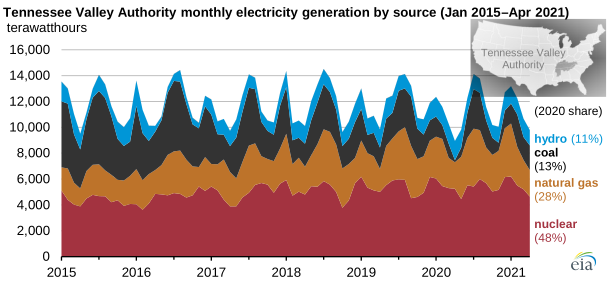
According to our Form EIA-923 survey data, about 53% of the electricity generated by the TVA between January 2015 and April 2021 came from non-fossil fuel sources, mostly nuclear and hydroelectric power. Nuclear energy provided 43% of the TVA’s total electricity net generation over that time period, and hydroelectricity accounted for 10% of the TVA’s total. Coal (24%) and natural gas (23%) made up almost all the rest of the TVA’s electricity generation. Coal’s share of the TVA’s total electricity net generation decreased from 36% in 2015 to 13% in 2020. Nuclear and hydroelectricity replaced the bulk of coal’s lost generation share.
According to our State Electricity Profiles, Tennessee ranks in the top 15 states in total electricity consumption. Tennessee imports electricity from other states to meet nearly one-quarter of its demand. In 2019, the average price of electricity in Tennessee was 9.69 cents per kilowatthour, slightly less than the national average of 10.54 cents per kilowatthour.
Additional state-level analysis for all types of energy sources is available in our State Energy Portal.
Principal contributor: Brett Marohl
Tags: generation, coal, electricity, natural gas, nuclear, hydroelectric, Tennessee, states