
EIA’s 50% Carbon-Free Generation side case projects little effect on CO2 emissions
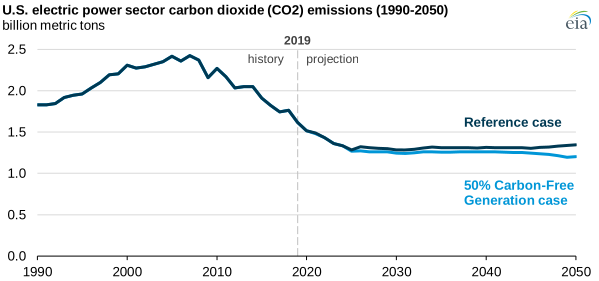
Last week, the U.S. Energy Information Administration (EIA) released an Issue in Focus supplement to its Annual Energy Outlook 2020 (AEO2020). The supplement discusses alternative policy cases that analyze uncertainty around recently enacted legislation and potential changes to laws and regulations. One of these alternative policy cases, the 50% Carbon-Free Generation case, increases requirements in state-level policies to 50% carbon-free generation in all states by 2050, which includes generation for renewables, nuclear, and carbon-capture and sequestration technologies. In this case, several nuclear power plants remain online instead of retiring.
As of the beginning of 2020, 29 U.S. states and the District of Columbia have adopted renewable portfolio standards (RPS)—policies that are designed to increase the portion of electricity generated from renewable sources. In recent years, several states revised their existing RPS into carbon-free electricity standards that expand the list of eligible technologies, increase the target share of clean energy, and revise the target dates. By expanding the list of eligible technologies from just renewables to a broader group of carbon-free sources—especially nuclear power, which accounted for 20% of electricity generation in 2019—states can set and meet more ambitious CO2 emissions reduction targets.
At the national level, the United States already generated 40% of its electricity using carbon-free technologies in 2019, including sources such as nuclear, hydropower, wind, solar, and several others. In the AEO2020 Reference case, which assumes current laws and regulations remain as enacted throughout the projection period, the carbon-free electricity generation share increases to more than 50% at the national level by 2050, although some regions remain at less than 50%. In the 50% Carbon-Free Generation case, all states achieve at least 50% of electricity sales from carbon-free or low-carbon generation sources by 2050. At the national level, 59% of electricity sales in this alternative case are from carbon-free or low-carbon generation sources by 2050.
Carbon-free and low-carbon generating technologies include renewable sources such as wind and solar, nuclear, hydroelectric, and certain fossil-fuel generation that uses carbon capture and sequestration technologies (carbon capture and storage). Other technologies that commonly qualify under clean energy policies in several states include geothermal, biomass, and municipal solid waste, and these technologies are considered carbon-free in this case.
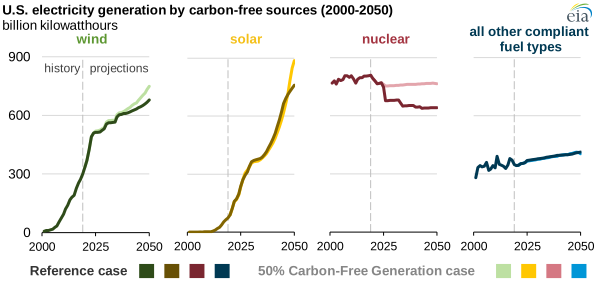
In the 50% Carbon-Free Generation case, wind and solar photovoltaic (PV) generation levels are similar to those in the Reference case until later in the projection period. By 2050, the United States has 10% more generation from wind and 17% more generation from solar PV than in the Reference case, respectively. Nuclear power produces 19% more electricity generation in 2050 compared with the AEO2020 Reference case.
Principal contributor: Richard Bowers