
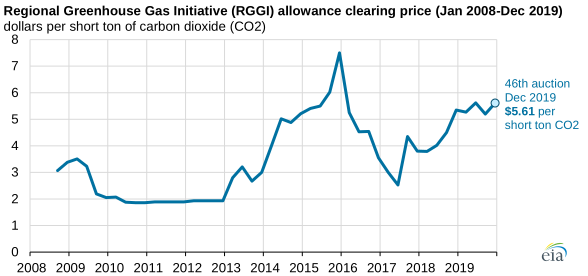
Auction prices for regional carbon dioxide allowances have increased since the 2017 low
The Regional Greenhouse Gas Initiative (RGGI) is the first mandatory market-based program in the United States intended to reduce greenhouse gas emissions. RGGI was formed as a cooperative effort among 10 northeastern states to cap and reduce carbon dioxide (CO2) emissions from the participating states’ power sectors. RGGI CO2 emission allowances are available to affected companies and other interested parties at quarterly auctions.
RGGI held its 46th quarterly allowance auction on December 4, 2019, resulting in a clearing price of $5.61 per short ton for the 13.1 million tons of CO2 allowances sold. The December clearing price was almost the same as the June 2019 price—the highest since December 2015—and 5% higher than the $5.35 per short ton price at the December 2018 auction.
RGGI began in 2009 as a cooperative effort among 10 states: Connecticut, Delaware, Maine, Maryland, Massachusetts, New Hampshire, New York, Rhode Island, New Jersey, and Vermont. RGGI is implemented through CO2 Budget Trading Programs in each participating state. The RGGI CO2 cap is a regional budget for CO2 emissions from the power sector and represents the total of all 10 state program targets. Pennsylvania’s and Virginia’s state legislatures are considering RGGI membership; New Jersey left the initiative in 2012 but reentered in 2018.
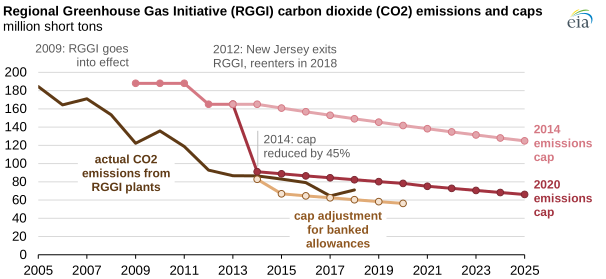
Because of the large surplus in RGGI allowance markets in its early years, a program review conducted in 2012 resulted in a tighter emissions cap and other program changes that went into effect in 2014. In that year, the RGGI states announced two adjustments to the RGGI cap to account for CO2 allowances that were banked in previous years (2009 through 2013). The combined effect of these adjustments lowers the cap to 56.3 million short tons in 2020, compared with the original 2020 target set in 2014 of 78.2 million short tons. Post-2020 cap levels will be established through subsequent program reviews, as discussed in the Principles to Accompany Model Rule Amendments and 2017 Model Rule.
RGGI states also established a Cost Containment Reserve (CCR), a quantity of allowances held in reserve, in addition to the cap, that are only made available for sale if allowance prices exceed predefined price levels. The CCR will only go into effect if the market mechanism results in emission reduction credit prices that are higher than projected. In 2021, the CCR will be triggered if CO2 prices reach $13.00 per short ton. That trigger price is set to increase by 7% annually in subsequent years.
Principal contributor: O. Nilay Manzagol
Tags: emissions, CO2 (carbon dioxide)