
Efficiency requirements for residential central AC and heat pumps to rise in 2023
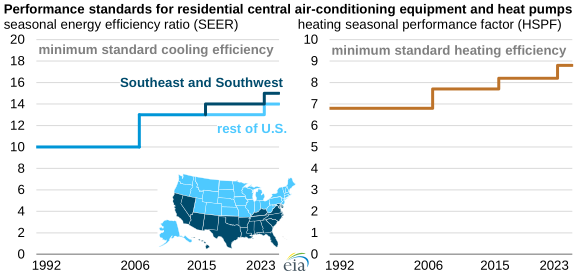
Beginning in 2023, all new residential central air-conditioning and air-source heat pump systems sold in the United States will be required to meet new minimum energy efficiency standards. The most recent minimum energy efficiency standards for these equipment types went into effect in 2015, and for the first time, separate standards were set for cooling central air conditioners sold in the northern parts of the United States and those sold in the southern parts. The new standards continue to set different cooling efficiency levels for air conditioners in the south, and they also require an increase in the heating efficiency of all air-source heat pumps.
The Energy Policy and Conservation Act (EPCA) of 1975 first gave the U.S. Department of Energy (DOE) authority to develop, revise, and implement minimum energy conservation standards for appliances and equipment. EPCA requires DOE to periodically amend energy conservation standards for certain equipment, but only if the amendments are energy-saving, technologically feasible, and economically justifiable.
The National Appliance Energy Conservation Act of 1987 established the first minimum efficiency requirements for central air-conditioning and heat pump equipment sold in the United States. These standards went into effect in 1992, and later updates went into effect in 2006 and 2015.
The new standards effective in 2023 require a seasonal energy efficiency ratio (SEER)—a measure of a system’s cooling performance—of no less than 14 SEER for residential systems in the northern part of the United States and 15 SEER in the southern part of the United States, where cooling loads are a larger share of home energy use. Higher SEER ratings indicate more energy-efficient equipment.
In addition, the new standards require an increase in the heating efficiency of air-source heat pumps—measured by the equipment’s heating seasonal performance factor (HSPF). The minimum HSPF will be 8.8 HSPF compared with the 8.2 HSPF required by the current standard that went into effect in 2015.
The U.S. Energy Information Administration’s (EIA) 2015 Residential Energy Consumption Survey (RECS) estimates that 76 million primary occupied U.S. homes (64% of the total) use central air-conditioning equipment, and about 13 million homes (11%) use heat pumps for heating or cooling. When defining the new standards, DOE calculated that, in total, households using central air conditioners or heat pumps will collectively save $2.5 billion to $12.2 billion on energy bills during the 30-year period following implementation of the standards.
Principal contributors: Olivia Clark, Kevin Jarzomski
Tags: residential, efficiency