
NERC report highlights potential summer electricity issues for Texas and California
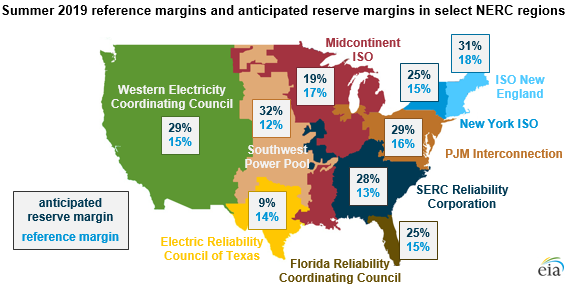
The North American Electric Reliability Corporation's (NERC) recent 2019 Summer Reliability Assessment finds that enough resources are available to meet this summer's projected peak electricity demand in all areas of the country except the Electric Reliability Council of Texas (ERCOT). ERCOT typically has one of the lowest anticipated reserve margins in the country, meaning it may have relatively little unused electric generating capacity during times of peak electric load. NERC’s assessment also highlighted potential ramping issues associated with the growth in solar generation that may affect the California Independent System Operator (CAISO).
NERC is a nonprofit corporation that oversees regional electric reliability entities in the Lower 48 United States, Canada, and parts of Mexico. Before each summer, NERC publishes a reliability assessment that tabulates anticipated electricity demand and supply changes and highlights any regional challenges or expected conditions that may affect the bulk power system.
Among the most relevant metrics in NERC’s assessment are the anticipated reserve margin and planning reference margins for each region.
- The anticipated reserve margin considers the amount of anticipated resources (capacity to generate) relative to net internal electricity demand. A reserve margin of 15% means that 15% of a region’s electric generating capacity would be available as a buffer to supply the summer’s peak hourly load.
- Planning reference margins are reserve margin targets based on each area's load, generation capacity, and transmission characteristics. In some cases, the planning reference margin level is required by states, provinces, independent system operators, or other regulatory bodies. Reliability entities in each region aim to have their anticipated reserve margins surpass their planning reference margins.
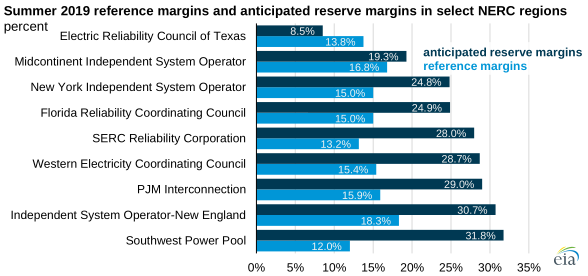
As in previous assessments, ERCOT is the only region in the Lower 48 states where the anticipated reserve margin (8.5%) is lower than the region’s reference margin (13.8%). According to NERC, ERCOT’s anticipated reserve margin this summer is lower than last summer’s (10.9%) because of load growth, delays in new sources of electricity generation, and the announced mothballing (i.e., removal from operating service) of the 470-megawatt Gibbons Creek coal-fired plant.
In its summer 2019 assessment of resource adequacy, ERCOT anticipates reaching a new peak hourly electricity demand level of 74,853 megawatts (MW), or about 1,300 MW higher than the hourly demand record set last July. If resource shortfalls occur, ERCOT expects to import additional power, if available, and issue energy emergency alerts that ask consumers to voluntarily reduce their electricity use.
NERC’s report also described potential issues for CAISO, which covers much of California. More solar-powered generators in California mean that other forms of generation must quickly ramp up or ramp down to ensure that overall electricity supply closely matches demand.
During times of shortages of ramping resources, CAISO will likely import more electricity from neighboring areas. Potential issues such as extreme temperatures and wildfires that would affect regional electricity resources increase operational issues for the bulk power system.
In CAISO’s assessment of summer resources, it expects to face less risk this summer relative to last summer in part because of greater-than-normal hydro conditions in the region. However, CAISO acknowledges that the system will be at greater risk in the late summer when hydroelectric output typically falls and electricity demand remains high.
Principal contributor: Owen Comstock