
U.S. coal production fell in first half of 2017 after increasing in late 2016
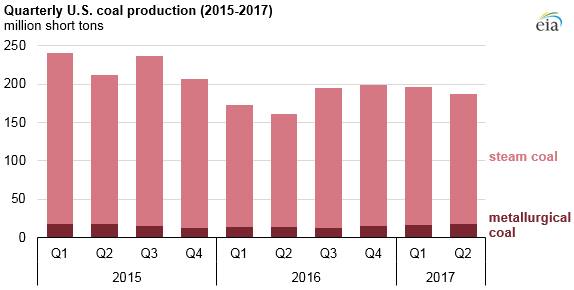
U.S. coal production averaged 192 million short tons (MMst) per quarter in the first half of 2017, a slight decrease from the second half of 2016 but still above levels reached in the first half of 2016. The recent decline in production was a result of weaker demand for steam coal, about half of which is mined in Wyoming and Montana. Production of metallurgical coal, which is used in steel manufacturing and makes up about 8% of total U.S. coal production, increased for the third consecutive quarter.
Demand for steam coal, which in the first half of 2017 made up more than 90% of U.S. coal production, is driven by coal-fired electricity generation. In recent years, coal has lost part of its electricity generation share to other fuels, but it still accounted for 30% of the U.S. electricity generation mix in the first half of 2017 compared with natural gas and renewables (including hydro) at 31% and 20%, respectively.
The largest reductions in demand for steam coal in the second quarter of 2017 occurred in Illinois, Kansas, and Minnesota, which together accounted for nearly half of the total U.S. decline in steam coal consumption. The overall decline in coal demand resulted in a reduction of 11.7 MMst in total steam coal production in the second quarter of 2017, 8.1 MMst of which was coal mined from the Powder River Basin in Wyoming and Montana.

In contrast, average quarterly metallurgical coal production increased from 14.1 MMst in the second half of 2016 to 16.8 MMst in the first half of 2017, driven by higher worldwide demand, particularly from China, Japan, and India. U.S. metallurgical coal exports to Asia increased as China, Japan, and India looked to offset disruptions to their supply of Australian coal caused by Cyclone Debbie in April 2017. In addition, China’s demand for metallurgical coal increased as its steel production reached record levels in June, according to the National Bureau of Statistics of China.
Principal contributor: Brian Park
Tags: China, coal, production/supply