U.S. Energy Information Administration logo
Skip to sub-navigation
September 7, 2011

U.S. exports of petroleum products increase as markets become more globally integrated
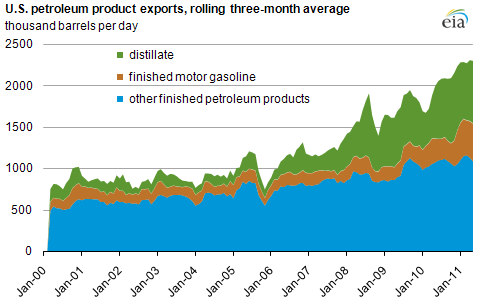
graph of U.S. petroleum product exports, rolling three-month average, as described in the article text
Source: U.S. Energy Information Administration, Petroleum Supply Monthly, Exports.
Note: Other finished petroleum products include residual fuel, kerosene-type jet fuel, napthas, asphalt, petroleum coke and other oils.
Download CSV Data

Total U.S. exports of finished petroleum products have increased more than 60% since 2007 as markets have become more globally integrated. This trend is driven primarily by finished motor gasoline and distillate fuel oil which are increasingly exported to Latin America. Annual U.S. exports of gasoline and distillate increased by 133% and 144%, respectively, from 2007 to 2010.

Both exports and imports are a normal part of global trade, but the volume of petroleum products exported from the United States is a small portion of U.S. consumption of those products. From 2000 through 2009, motor gasoline exports were generally 1% - 2% of motor gasoline product supplied (a proxy for demand). From 2010 to mid-2011, they have averaged close to 4%, reaching a high in December 2010 of 5.8%. Distillate exports, which include diesel fuels and fuel oils, represent a more significant share of total available product. From 2000 to 2008, distillate exports were less than 10% of distillate product supplied in all but two months. From the beginning of 2009 to mid-2011, distillate exports were more than 10% of distillate product supplied.
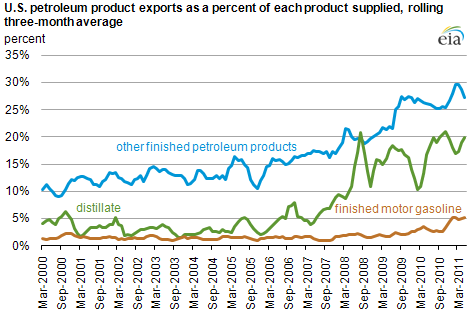
graph of U.S. petroleum product exports as a percent of each product supplied, rolling three-month average, as described in the article text
Source: U.S. Energy Information Administration, Petroleum Supply Monthly, Exports.
Note: Other finished petroleum products include residual fuel, kerosene-type jet fuel, napthas, asphalt, petroleum coke and other oils.
Download CSV Data

In petroleum product markets, Europe and Canada have been the traditional trading partners of the United States, with the volume of products shipped across the Atlantic tied in large part to the current price differences for delivery to the New York Harbor compared to Rotterdam, Amsterdam.

Over the last several years, other regions have become increasingly involved in the trade of petroleum products. Rising demand and tight supply in Latin America, together with a decline or leveling off of U.S. product demand, have have led to the growth in U.S. exports to that region.

Statistics
Analysis
Tools
Education
News

Petroleum & Other Liquids

Crude oil, gasoline, heating oil, diesel, propane, and other liquids including biofuels and natural gas liquids.

Natural Gas

Exploration and reserves, storage, imports and exports, production, prices, sales.

Electricity

Sales, revenue and prices, power plants, fuel use, stocks, generation, trade, demand & emissions.

Coal

Reserves, production, prices, employment and productivity, distribution, stocks, imports and exports.

Nuclear & Uranium

Uranium fuel, nuclear reactors, generation, spent fuel.

Renewable & Alternative Fuels

Includes hydropower, solar, wind, geothermal, biomass and ethanol.

EIA Survey Forms

Forms EIA uses to collect energy data including descriptions, links to survey instructions, and additional information.

Total Energy

Comprehensive data summaries, comparisons, analysis, and projections integrated across all energy sources.

U.S. States

State energy information, including overviews, rankings, data, and analyses.

International

International energy information, including overviews, rankings, data, and analyses.

Environment

Greenhouse gas data, voluntary reporting, electric power plant emissions.

Data Tools, Apps, & Maps

Tools to customize searches, view specific data sets, study detailed documentation, and access time-series data.

Open Data

EIA's free and open data available as API, Excel add-in, bulk files, and widgets

EIA Beta

Come test out some of the products still in development and let us know what you think!

Open Source Code

EIA's open source code, available on GitHub.

RSS Feeds

Subscribe to feeds for updates on EIA products including Today in Energy and What's New.