
Microchannel gas-to-liquid plants convert stranded natural gas to marketable products
Republished November 14, 2016, 12:00 p.m. to correct the planned capacity of the GTL plant in Wharton, Texas.
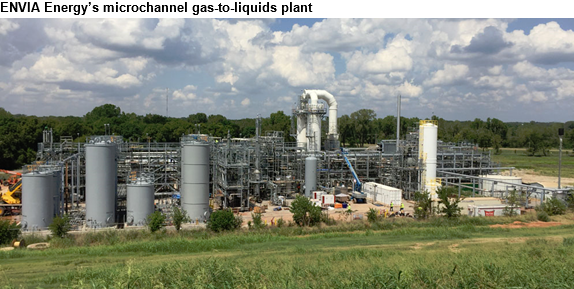
The first microchannel gas-to-liquid (GTL) plant in the United States was completed in September. The new plant, built by ENVIA Energy, is located in Oklahoma and is expected to begin converting landfill gas into liquid petroleum products later this year.
GTL plants convert natural gas to higher-valued petroleum products, including liquid fuels, waxes, and chemical feedstocks. The most common conversion method is the Fischer-Tropsch (F-T) process, which involves a series of chemical reactions that transform natural gas (or a gasified solid fuel, such as coal or biomass) into hydrocarbons and water. Six large-scale F-T GTL plants operate in the world today: two in South Africa, two in Qatar, and one each in Malaysia and Nigeria. These plants have output capacities ranging from 5,600 barrels per day (b/d) to 140,000 b/d. BP operated a smaller, 300 b/d pilot plant in Alaska from 2002 to 2009, but no commercial-scale GTL plants currently operate in the United States.
Once commissioned, ENVIA Energy’s plant will have a capacity of 300 b/d. For comparison, a petroleum refinery on the U.S. Gulf Coast may have a capacity of tens or hundreds of thousands of barrels per day. The project is a joint venture between four companies that plan to build more microchannel GTL plants at landfill sites. Several other companies are also developing microchannel GTL plants in the United States, including a 100 b/d plant scheduled to be completed next month in Wharton, Texas.
Because F-T reactions require high temperature and pressure, building a suitable reaction vessel can be expensive. High capital costs, coupled with market uncertainty regarding natural gas and petroleum product prices, has led several companies to develop different techniques.
High temperatures and pressures are less costly to maintain at smaller volumes. Small-scale F-T GTL plants can use microchannel reactors (diameters of one millimeter or less) to optimize their operation. The small diameters of the reactor vessels allow for better temperature control and reduce mass-transfer inefficiencies, but they limit overall flow rate. The smaller plants can also be sited in areas unable to accommodate large-scale industrial facilities.
Small GTL plants can be built close to isolated sources of excess methane (stranded gas). Landfill gas—primarily methane and carbon dioxide—is one example of a typical stranded gas; another is associated natural gas produced in oil fields that have little or no natural gas infrastructure. GTL plants in such places could potentially obtain feed gas at steep discounts or even for free, since stranded gas is usually flared (burned off) or vented (allowed to dissipate into the atmosphere). Small-scale GTL plants could become a more attractive option than flaring in the future, depending on the finalized version of rules initially proposed in February 2016 by the Bureau of Land Management designed to limit the amount of methane flared or vented from oil and natural gas production activities. If this gas were converted to liquid instead, it could be transported by vehicle or pipeline and sold.
Principal contributors: Nicholas Skarzynski, Mindi Farber-DeAnda
Tags: liquid fuels, natural gas