U.S. Energy Information Administration logo
Skip to sub-navigation
September 6, 2016

California is using more renewables and less natural gas in its summer electricity mix
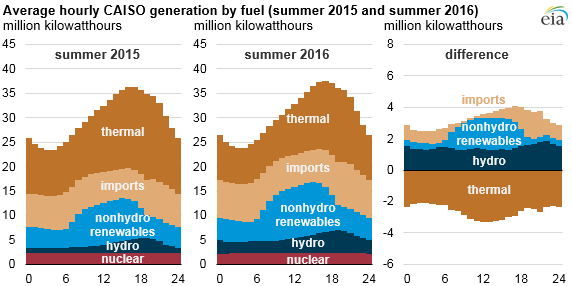
graph of average hourly CAISO generation by fuel, as explained in the article text
Source: U.S. Energy Information Administration, California Independent System Operator (CAISO) as accessed through ABB Velocity Suite
Note: Summer is defined as June, July, and August.

The mix of energy sources used for power generation in California this summer changed from last summer, as renewables and imported electricity offset lower natural gas use. During summer 2016 (June, July, and August), thermal generation (almost all from natural gas) in the area serviced by the California Independent System Operator (CAISO) was down 20% from the previous summer, while generation from hydroelectricity, other renewables, and electricity imports was higher than the same period last year. The overall level of electricity consumption was 2% higher this summer as temperatures were slightly warmer than the previous summer.

Hydroelectric generation in CAISO increased from last summer because the West Coast drought situation has improved. According to the U.S. Drought Monitor, 59% of California experienced a severe, extreme, or exceptional drought during July 2016. In contrast, 95% of the state experienced similar conditions last July. These improved water conditions have also helped increase hydroelectric generation in the Pacific Northwest, some of which is imported into CAISO.

The addition of new generating capacity has also contributed to the change in generation mix. Data from CAISO indicate that nonhydro renewables, mainly solar and wind, represented 26% of capacity in June 2016. Utility-scale solar photovoltaic (PV) capacity has shown the most growth in CAISO recently, increasing by 1.4 gigawatts (27%) between June 2015 and June 2016. This increase in utility-scale solar capacity has reduced the need for summer thermal generation in CAISO, especially during the daylight hours.
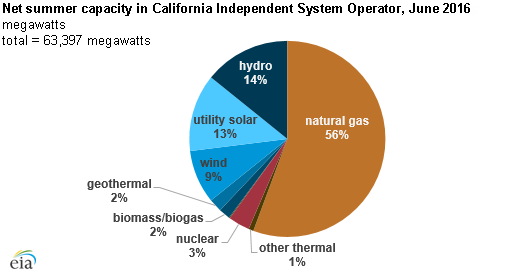
graph of net summer capacity in CAISO, as explained in the article text
Source: U.S. Energy Information Administration, California Independent System Operator (CAISO) as accessed through ABB Velocity Suite

California also has added a significant amount of distributed solar PV capacity. EIA's latest data show that distributed solar PV increased from 2.8 gigawatts in June 2015 to 3.8 gigawatts in June 2016. Distributed generation reduces the amount of electricity that utility-scale power plants need to supply.

Principal contributor: Nilay Manzagol

Statistics
Analysis
Tools
Education
News

Petroleum & Other Liquids

Crude oil, gasoline, heating oil, diesel, propane, and other liquids including biofuels and natural gas liquids.

Natural Gas

Exploration and reserves, storage, imports and exports, production, prices, sales.

Electricity

Sales, revenue and prices, power plants, fuel use, stocks, generation, trade, demand & emissions.

Coal

Reserves, production, prices, employment and productivity, distribution, stocks, imports and exports.

Nuclear & Uranium

Uranium fuel, nuclear reactors, generation, spent fuel.

Renewable & Alternative Fuels

Includes hydropower, solar, wind, geothermal, biomass and ethanol.

EIA Survey Forms

Forms EIA uses to collect energy data including descriptions, links to survey instructions, and additional information.

Total Energy

Comprehensive data summaries, comparisons, analysis, and projections integrated across all energy sources.

U.S. States

State energy information, including overviews, rankings, data, and analyses.

International

International energy information, including overviews, rankings, data, and analyses.

Environment

Greenhouse gas data, voluntary reporting, electric power plant emissions.

Data Tools, Apps, & Maps

Tools to customize searches, view specific data sets, study detailed documentation, and access time-series data.

Open Data

EIA's free and open data available as API, Excel add-in, bulk files, and widgets

EIA Beta

Come test out some of the products still in development and let us know what you think!

Open Source Code

EIA's open source code, available on GitHub.

RSS Feeds

Subscribe to feeds for updates on EIA products including Today in Energy and What's New.