
Hydroelectric plants account for more than 70% of Brazil's electric generation
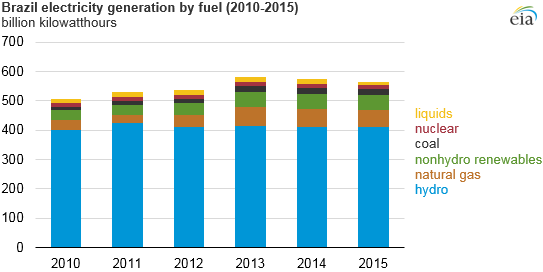
Republished March 16, 2017, to correct an error in the graph.
Brazil generates the third-highest amount of electricity in the Americas, behind only the United States and Canada. Hydroelectricity provides more than 70% of Brazil's generation. During the Olympic Games, electricity demand in the host city of Rio de Janeiro has risen from an influx of tourists, athletes, and event staff.
Uncertainty over water supply has led to operational challenges for local utilities in Brazil. Recently, southeastern Brazil experienced a three-year drought that was exacerbated by the strong 2015–16 El Niño event, which made it the worst water shortage event in the region in 35 years. As hydroelectric output fell during this period, generation from other fuels such as natural gas and liquid fuels increased. Brazil's drought situation improved in early 2016 with the arrival of the rainy season.
Brazil currently has 158 hydroelectric plants in operation, which total more than 89 gigawatts (GW), with 9 additional plants under construction and another 26 authorized. The 11-GW Belo Monte plant, when complete, will be the third-largest hydroelectric power plant in the world. With the plants under construction and authorized, Brazil's hydroelectric generation capacity is projected to expand to 112 GW by 2024.
Though short-term economic factors have temporarily slowed Brazil's electricity demand growth, Brazil intends to diversify its generation mix in the coming years. The 2024 Brazilian Energy Plan calls for expanding development of nonhydro renewable generation technologies by 36 GW, natural gas generation capacity by 11 GW, and nuclear generation capacity by 1.4 GW from 2014 levels. EIA's International Energy Outlook 2016 projects that Brazil's GDP and electricity demand will grow at average annual rates of 2.4% and 2.0%, respectively, from 2014 through 2024.
Principal contributor: Slade Johnson, Kirstin Berndt
Tags: Brazil, electricity, generation, hydroelectric, renewables