
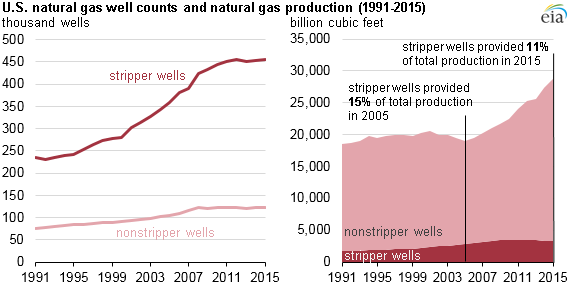
Stripper wells accounted for 11% of U.S. natural gas production in 2015
Note: Results can vary because of the types of wells, completions, and leases included in the analysis, update schedules of source databases, and estimation results for a number of late-reporting states.
Stripper wells, also known as marginal wells, individually produce small volumes of natural gas or oil but in aggregate have provided 11% to 15% of total U.S. oil and natural gas production over the past decade. Natural gas stripper wells (so called because they are stripping the remaining natural gas out of the ground) are characterized as producing no more than 90,000 cubic feet per day over a 12-month period. EIA estimates that there were about 456,000 stripper gas wells in the United States operating at the end of 2015, compared with about 122,000 nonstripper gas wells.
These well counts include natural gas wells that may also produce some oil. Wells producing more than 6,000 cubic feet of natural gas per barrel of oil are considered gas wells, while wells producing 6,000 or less cubic feet of natural gas per barrel of oil are considered oil wells. Stripper wells contribute a small but significant portion of production of both natural gas and oil.
Stripper wells may have originally been high-volume wells, but through normal production declines now produce only small volumes. Because these wells usually have low ongoing maintenance costs, they are kept active and may continue to produce for many years, as long as they are economically feasible.
Despite each stripper well's small individual production, in aggregate they make a contribution to total natural gas production. The production share of stripper gas wells has remained relatively constant over the past 25 years, rising from about 10% in 1991 to 15% in 2006–09 and dropping again to about 11% in 2015. The recent decrease in stripper wells' share of total production reflects the large increase in production from relatively prolific wells drilled in shale and tight gas formations with enhanced completion techniques. Because these wells, and nonstripper wells in general, produce at a much higher rate than stripper wells, they account for the bulk of total U.S. natural gas production.
Principal contributor: Jack Perrin