U.S. Energy Information Administration logo
Skip to sub-navigation
April 12, 2016

Canada provides record-high share and amount of U.S. crude oil imports in 2015
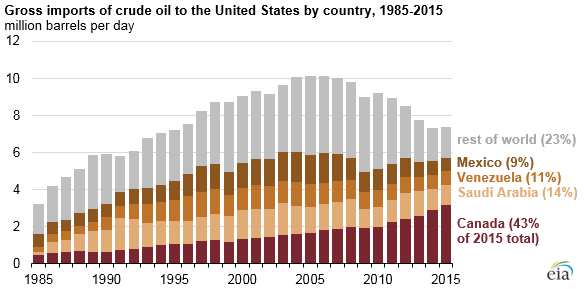
graph of gross imports of crude oil to the United States by country, as explained in article text
Source: U.S. Energy Information Administration, Petroleum Supply Monthly

Although total U.S. crude oil imports in 2015 continued to be lower than levels reached during the mid-2000s, imports from the United States' top foreign oil supplier—Canada—were the highest on record, according to annual trade data from EIA's Petroleum Supply Monthly. Canada provided 4 out of every 10 barrels of oil imported into the United States in 2015.

U.S. gross crude oil imports from all sources averaged 7.4 million barrels per day (b/d) in 2015, down 27% since the 2005 high of 10.1 million b/d. As gross crude oil imports decline, a growing share of remaining imports are being sourced from four top suppliers: Canada, Saudi Arabia, Venezuela, and Mexico. Canada, America's largest crude oil supplier since 2004, sent a record-high 3.2 million b/d of gross crude oil exports to the United States in 2015, up 10% from the year before, accounting for a record 43% of total U.S. crude oil imports. Canada also receives nearly all U.S. crude oil exports, making up 422,000 b/d, or 92%, of the 458,000 b/d of crude oil exported from the United States in 2015.

Canada generally produces heavy, sour crude oil that is well-matched to processing capacity in the United States, where many refineries have the equipment needed to process such oil. Canada has few alternative outlets for the heavy crude produced in Alberta, where most of Canada's proved oil reserves are located. Canada is expected to continue to provide a large share of U.S. oil imports for the foreseeable future, especially given the expansion of pipeline and rail shipping capacities to transport Canadian oil.

Principal contributor: Tom Doggett

Statistics
Analysis
Tools
Education
News

Petroleum & Other Liquids

Crude oil, gasoline, heating oil, diesel, propane, and other liquids including biofuels and natural gas liquids.

Natural Gas

Exploration and reserves, storage, imports and exports, production, prices, sales.

Electricity

Sales, revenue and prices, power plants, fuel use, stocks, generation, trade, demand & emissions.

Coal

Reserves, production, prices, employment and productivity, distribution, stocks, imports and exports.

Nuclear & Uranium

Uranium fuel, nuclear reactors, generation, spent fuel.

Renewable & Alternative Fuels

Includes hydropower, solar, wind, geothermal, biomass and ethanol.

EIA Survey Forms

Forms EIA uses to collect energy data including descriptions, links to survey instructions, and additional information.

Total Energy

Comprehensive data summaries, comparisons, analysis, and projections integrated across all energy sources.

U.S. States

State energy information, including overviews, rankings, data, and analyses.

International

International energy information, including overviews, rankings, data, and analyses.

Environment

Greenhouse gas data, voluntary reporting, electric power plant emissions.

Data Tools, Apps, & Maps

Tools to customize searches, view specific data sets, study detailed documentation, and access time-series data.

Open Data

EIA's free and open data available as API, Excel add-in, bulk files, and widgets

EIA Beta

Come test out some of the products still in development and let us know what you think!

Open Source Code

EIA's open source code, available on GitHub.

RSS Feeds

Subscribe to feeds for updates on EIA products including Today in Energy and What's New.