U.S. Energy Information Administration logo
Skip to sub-navigation
July 28, 2011

Ruby natural gas pipeline begins service today (July 28, 2011)
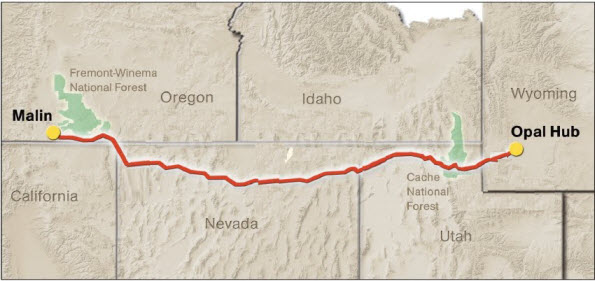
Ruby natural gas pipeline route
map of Ruby natural gas pipeline route
Source: U.S. Energy Information Administration based on El Paso Corporation project map.

El Paso Corporation's Ruby Pipeline (Ruby), the largest natural gas pipeline project dedicated to serving the Western United States since the expansion of the Kern River system in 2003, received approval from the Federal Energy Regulatory Commission (FERC) to commence service today (July 28, 2011). Initial scheduled volumes on Ruby's mainline heading west were about 65 million cubic feet.

Ruby transports natural gas from the Opal Hub in Wyoming west through Utah and Nevada and terminates at pipeline interconnects near Malin, Oregon. The initial design capacity of the 680-mile, 42-inch transmission pipeline is up to 1.5 billion cubic feet per day (Bcfd), increasing the regional capacity to move gas from the Rockies region to the West by over 50%. Ruby greatly enhances the ability to deliver natural gas into Northern California.

On July 30, 2010, Ruby received FERC approval to begin construction, which commenced the following day. The estimated in-service date for Ruby was Spring 2011, but project delays such as the onset of the nesting season for certain migratory birds slowed construction.

On July 11, 2011, Ruby requested authorization from FERC to commence service at a lowered Maximum Allowable Operating Pressure (MAOP): 10% lower than its designed MAOP. The reduced MAOP allowed Ruby flexibility to commence service prior to receiving approval from the Pipeline and Hazardous Material Safety Administration (PHMSA), which is required to flow natural gas at higher operating pressures.

Even at reduced pressure, Ruby will be able to fulfill its current firm capacity contract commitments of 1.2 Bcfd. Subsequently, Ruby will seek FERC authorization to raise its MAOP to the 1440 psig (pound-force per square inch gauge) level after Ruby obtains PHMSA's approval.

Statistics
Analysis
Tools
Education
News

Petroleum & Other Liquids

Crude oil, gasoline, heating oil, diesel, propane, and other liquids including biofuels and natural gas liquids.

Natural Gas

Exploration and reserves, storage, imports and exports, production, prices, sales.

Electricity

Sales, revenue and prices, power plants, fuel use, stocks, generation, trade, demand & emissions.

Coal

Reserves, production, prices, employment and productivity, distribution, stocks, imports and exports.

Nuclear & Uranium

Uranium fuel, nuclear reactors, generation, spent fuel.

Renewable & Alternative Fuels

Includes hydropower, solar, wind, geothermal, biomass and ethanol.

EIA Survey Forms

Forms EIA uses to collect energy data including descriptions, links to survey instructions, and additional information.

Total Energy

Comprehensive data summaries, comparisons, analysis, and projections integrated across all energy sources.

U.S. States

State energy information, including overviews, rankings, data, and analyses.

International

International energy information, including overviews, rankings, data, and analyses.

Environment

Greenhouse gas data, voluntary reporting, electric power plant emissions.

Data Tools, Apps, & Maps

Tools to customize searches, view specific data sets, study detailed documentation, and access time-series data.

Open Data

EIA's free and open data available as API, Excel add-in, bulk files, and widgets

EIA Beta

Come test out some of the products still in development and let us know what you think!

Open Source Code

EIA's open source code, available on GitHub.

RSS Feeds

Subscribe to feeds for updates on EIA products including Today in Energy and What's New.