
Power-to-gas brings a new focus to the issue of energy storage from renewable sources
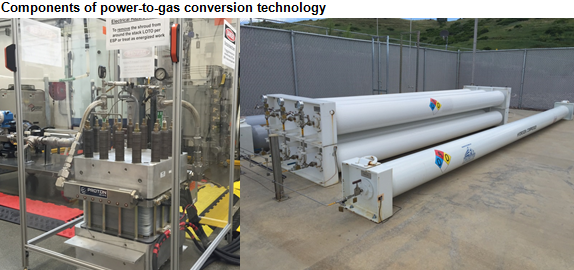
Note: Standard industrial electrolyzer (left) and dedicated hydrogen storage (right) will be engaged in power-to-gas conversion research. Commercial-grade systems will be significantly larger.
Large-scale electricity storage technologies are currently limited in use, with pumped hydroelectric storage accounting for more than 98% of total storage capacity. However, nonhydro storage is increasing, and there is considerable interest in developing new storage technologies with attractive costs and operating characteristics. Power-to-gas conversion is a potential storage solution that is undergoing advanced study and approaching commercial application.
A power-to-gas system converts electricity generated during periods of high output and low demand (such as strong wind during off-peak hours) by splitting water into hydrogen and oxygen through electrolysis. The hydrogen is stored for future use as fuel, while the oxygen may be sold for industrial use or released into the atmosphere.
There are three potential uses for the stored hydrogen:
- Using hydrogen gas directly (or blended with natural gas) in applications such as power generation or vehicle fuel
- Feeding fuel cells by injecting hydrogen and either oxygen or air into the cell to produce electricity from the resultant chemical reaction
- Combining the hydrogen (H2) with carbon dioxide (CO2) to create synthetic methane (CH4), which could be used as a replacement for natural gas
The commercial use of power-to-gas technology is primarily being considered in Europe, where it is being reviewed by the European Gas Research Group, as well as the energy departments of several nations. In Germany alone there are 18 different experimental programs being conducted. Power-to-gas conversion is also being evaluated for commercial application in the United States by the Southern California Gas Company, in conjunction with the U.S. Department of Energy's National Renewable Energy Laboratory and the National Fuel Cell Research Center at the University of California, Irvine.
This research is exploring various avenues for using hydrogen produced through electrolysis, including hydrogen injection into the natural gas pipeline and storage infrastructure, synthetic methane production through biomethanization, and fuel cell applications. The goal of these projects is to produce commercial-scale energy storage.
Power-to-gas is a storage solution that can help address grid-stability problems that arise when an increasing share of power is generated from sources that have a highly variable output. Solar and wind accounted for nearly 5% of U.S. net electricity generation in 2014, and they are forecast to account for a greater share of the emerging generation portfolio, particularly in scenarios where policies such as the Environmental Protection Agency's (EPA) proposed Clean Power Plan reduce reliance on existing fossil-fueled generation are implemented.
Currently, electric grid balancing is done through the increased use of conventional power stations when renewable power generation falls off, or in some cases through the disconnection of renewable sources when the amount of power generated exceeds the requirements or capacity of the distribution grid. In the future, renewable generation may provide new opportunities for energy storage, which is likely to continue to grow in importance.
Principal contributors: Scott Bradley, Warren Wilczewski
Tags: electricity, generation, natural gas, renewables, storage