U.S. Energy Information Administration logo
Skip to sub-navigation
July 2, 2015

Fossil fuels have made up at least 80% of U.S. fuel mix since 1900
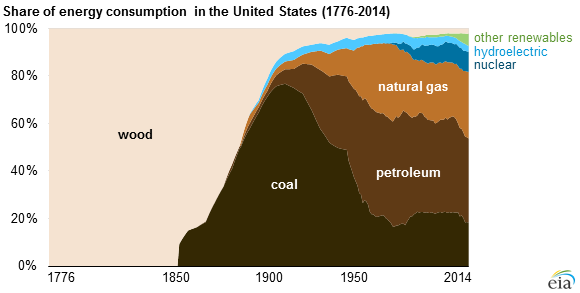
graph of share of energy consumption in the United States, as explained in the article text
Source: U.S. Energy Information Administration, Monthly Energy Review

While the energy history of the United States is one of significant change, three fossil fuel sources—petroleum, natural gas, and coal—have made up at least 80% of total U.S. energy consumption for more than 100 years. Recent increases in the domestic production of petroleum liquids and natural gas prompted shifts between the uses of fossil fuels (largely from coal-fired to natural gas-fired power generation), but the predominance of these three energy sources is likely to continue into the future.

For the first several decades of American history, families used wood (a renewable energy source) as a primary source of energy. Coal became dominant in the late 19th century before being overtaken by petroleum products in the middle of the 20th century, a time when natural gas usage also rose quickly. Since the mid-20th century, use of coal increased again (mainly as a primary energy source for electric power generation), and a new form of energy—nuclear electric power—emerged. After a pause in the 1970s, the use of petroleum and natural gas resumed growth. Petroleum consumption decreased in recent years, but natural gas has continued to provide a greater share of U.S. energy consumption. In the late 1980s, renewable energy consumption (other than wood and hydroelectric) began to appear, increasing significantly in the mid-2000s. In 2014, the renewable share of energy consumption in the United States was the highest (nearly 10%) since the 1930s, when wood represented a larger share of consumption. Renewable energy is a small but growing piece of the U.S. energy mix. The greatest growth in renewables today is in solar and wind power, which along with geothermal and biomass, are included in other renewables.
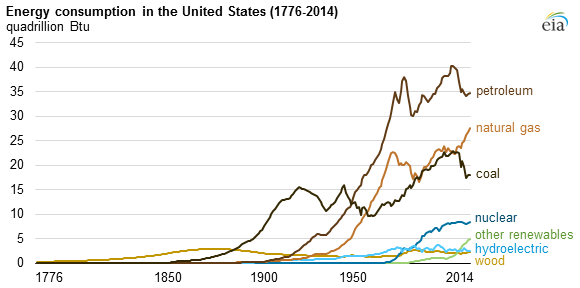
graph of energy consumption in the United States, as explained in the article text
Source: U.S. Energy Information Administration, Monthly Energy Review

Principal contributor: EIA Staff

Statistics
Analysis
Tools
Education
News

Petroleum & Other Liquids

Crude oil, gasoline, heating oil, diesel, propane, and other liquids including biofuels and natural gas liquids.

Natural Gas

Exploration and reserves, storage, imports and exports, production, prices, sales.

Electricity

Sales, revenue and prices, power plants, fuel use, stocks, generation, trade, demand & emissions.

Coal

Reserves, production, prices, employment and productivity, distribution, stocks, imports and exports.

Nuclear & Uranium

Uranium fuel, nuclear reactors, generation, spent fuel.

Renewable & Alternative Fuels

Includes hydropower, solar, wind, geothermal, biomass and ethanol.

EIA Survey Forms

Forms EIA uses to collect energy data including descriptions, links to survey instructions, and additional information.

Total Energy

Comprehensive data summaries, comparisons, analysis, and projections integrated across all energy sources.

U.S. States

State energy information, including overviews, rankings, data, and analyses.

International

International energy information, including overviews, rankings, data, and analyses.

Environment

Greenhouse gas data, voluntary reporting, electric power plant emissions.

Data Tools, Apps, & Maps

Tools to customize searches, view specific data sets, study detailed documentation, and access time-series data.

Open Data

EIA's free and open data available as API, Excel add-in, bulk files, and widgets

EIA Beta

Come test out some of the products still in development and let us know what you think!

Open Source Code

EIA's open source code, available on GitHub.

RSS Feeds

Subscribe to feeds for updates on EIA products including Today in Energy and What's New.