U.S. Energy Information Administration logo
Skip to sub-navigation
October 9, 2014

Lower petrochemical use of propane driven by wider price spread between propane and ethane
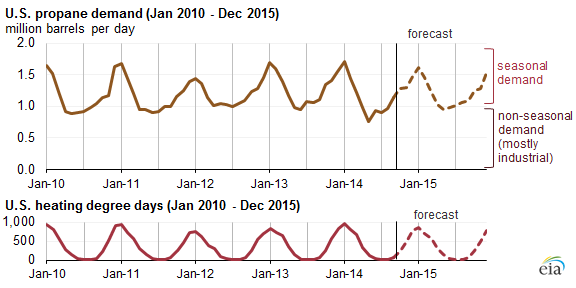
graph of U.S. propane demand and heating degree days, as explained in the article text
Source: U.S. Energy Information Administration, Short-Term Energy Outlook, October 2014
Note: Product supplied used as a proxy for propane demand.

Republished October 9, 9:45 a.m. to correct an error in the graph.

Propane demand (measured as product supplied) is expected to be 100,000 barrels per day (bbl/d) lower on average in 2014 compared to 2013 because of reduced demand from petrochemical plants, according to EIA's Short-Term Energy Outlook. In contrast to propane used as a heating fuel in buildings during colder months and as a crop-drying fuel during the harvest season, both of which are highly seasonal and weather dependent, petrochemical consumption of propane has relatively little seasonality.

Beginning in mid-2013, higher propane prices reduced demand from petrochemical users. This decline is evident after accounting for the seasonal variation in annual consumption: even though temperatures (as measured by heating degree days) were 9% colder in first-quarter 2014 compared to the previous year, propane consumption was 7% lower.

The primary chemical industry use for propane is as a feedstock for the production of ethylene and propylene, the basic building blocks of plastics. Ethylene producers are sensitive to feedstock prices. During 2013, when propane prices increased relative to ethane prices, ethylene crackers began substituting ethane for propane. This trend continued into 2014, as the price spread between propane and ethane widened.

graph of daily spot propane and ethane prices, as explained in the article text
Source: U.S. Energy Information Administration, based on Bloomberg

EIA does not expect ethylene plants to switch back to propane feedstock in the coming year, as growing ethane supply is expected to continue to lower ethane prices compared with propane. However, several new propane dehydrogenation plants, which use propane to produce propylene for chemical and plastic manufacturing, are expected to come online in 2015-16, which should contribute to some growth in propane use in the chemical industry.

Principal contributor: Stacy MacIntyre

Statistics
Analysis
Tools
Education
News

Petroleum & Other Liquids

Crude oil, gasoline, heating oil, diesel, propane, and other liquids including biofuels and natural gas liquids.

Natural Gas

Exploration and reserves, storage, imports and exports, production, prices, sales.

Electricity

Sales, revenue and prices, power plants, fuel use, stocks, generation, trade, demand & emissions.

Coal

Reserves, production, prices, employment and productivity, distribution, stocks, imports and exports.

Nuclear & Uranium

Uranium fuel, nuclear reactors, generation, spent fuel.

Renewable & Alternative Fuels

Includes hydropower, solar, wind, geothermal, biomass and ethanol.

EIA Survey Forms

Forms EIA uses to collect energy data including descriptions, links to survey instructions, and additional information.

Total Energy

Comprehensive data summaries, comparisons, analysis, and projections integrated across all energy sources.

U.S. States

State energy information, including overviews, rankings, data, and analyses.

International

International energy information, including overviews, rankings, data, and analyses.

Environment

Greenhouse gas data, voluntary reporting, electric power plant emissions.

Data Tools, Apps, & Maps

Tools to customize searches, view specific data sets, study detailed documentation, and access time-series data.

Open Data

EIA's free and open data available as API, Excel add-in, bulk files, and widgets

EIA Beta

Come test out some of the products still in development and let us know what you think!

Open Source Code

EIA's open source code, available on GitHub.

RSS Feeds

Subscribe to feeds for updates on EIA products including Today in Energy and What's New.