
U.S. coal exports fall on lower European demand, increased global supply
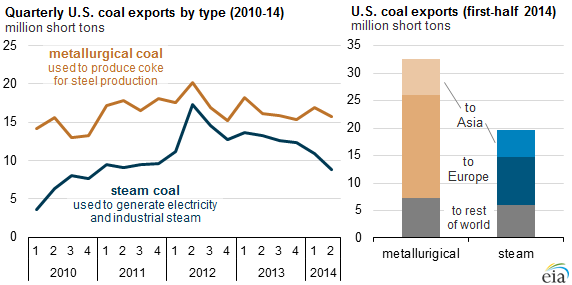
Republished October 3, 2014, 12:35 p.m., to clarify graph units.
U.S. coal exports have continued to decline from their record volumes in 2012. During the first half of 2014, coal exports totaled 52.3 million short tons (MMst), 16% below the same period in 2013. Most of these exports go to countries in Europe and Asia. Export declines reflect both lower European demand for steam coal and increased steam coal supply from Australia and Indonesia. Metallurgical coal supply from Australia, Canada, and Russia has also increased. These factors have led to a cumulative decline of 9.0 MMst in coal exports to Europe and Asia during the first half of 2014.
Coal exports fall into two categories: metallurgical coal, which is used in the production of steel, and steam coal, which is commonly used to fuel boilers that generate steam used to produce electricity. With relatively minor coal imports, the United States has been a net exporter of coal since 1949, the earliest year of data collection.
Metallurgical coal production, primarily from the Illinois and Appalachian coal basins, represented less than 8% of production but 56% of total U.S. coal exports in 2013. Europe is the leading destination for metallurgical coal exports, followed by Asia. Together, these two regions accounted for nearly 80% of U.S. metallurgical coal exports in the first half of 2014.
Steam coal is mainly used to generate electricity, but also has applications at combined heat and power plants to produce steam used in industrial processes. Steam coal generally has lower heat content than metallurgical coal and can be found at most coal-producing basins in the United States. In recent years, steam coal accounted for more than 90% of domestic coal production. During the first half of 2014, Europe received 8.8 MMst of U.S. steam coal exports, a drop of 7.4 MMst from the same period in 2013. Asia's share of U.S. steam coal exports increased in 2014, but export tonnage to Asia decreased 2.4% from the first half of 2013.
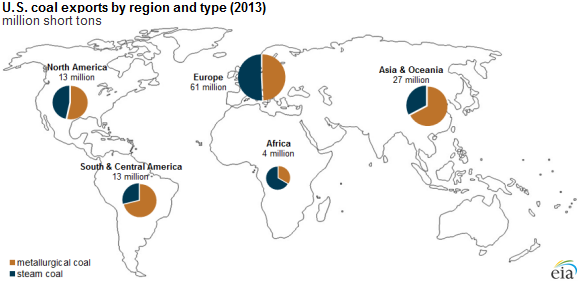
In 2013, six U.S. ports shipped 89% of U.S. coal exports. Among them, eastern ports Baltimore and Norfolk represent 55%; and southern ports Houston, Mobile, and New Orleans make up 30%. Seattle accounted for 5 MMst, or 4%, all of which was steam coal exports. Eastern and southern ports are used to export metallurgical coal because it is produced in the Illinois and Appalachian Basins.
Detailed export data by year, country, coal type, and customs district are available through EIA's Coal Data Browser.
Principal contributors: Elias Johnson, Tejasvi Raghuveer
Tags: coal, Europe, exports/imports, international, map