
Steam coal imports remain down sharply from historic high in 2007
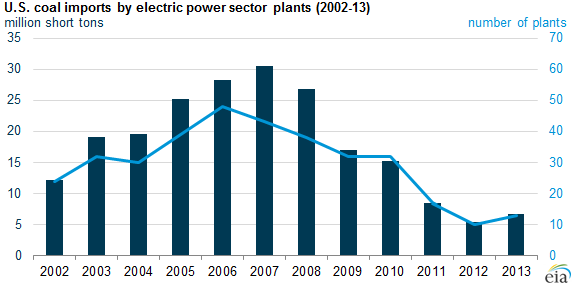
Note: The number of reported plants excludes transfer terminals. Data for 2013 are preliminary.
Steam coal imports at electric power plants have fallen significantly from their peak level of more than 30 million tons in 2007 to less than 7 million in 2013. The number of plants using imported coal similarly fell from a peak of 48 in 2006 to 13 in 2013. Preliminary data for the first five months of 2014 indicate an increase in both imports and the number of plants taking imports, but both are still well below 2007 levels. Coal imports, mainly from Colombia but also from countries including Venezuela, Indonesia, and Canada, remain a small component of overall U.S. coal consumption—only 3% during the peak year of 2007 and less than 1% in 2013.
Although the United States has abundant supplies of domestic coal, some power plants along the East Coast and the Gulf Coast receive imported coal. Imported coal accounted for between 25% and 50% of total annual coal receipts for the top coal-importing plants from 2002 to 2013. Plants in these areas are subject to relatively higher cost of eastern rail transport and in some cases are limited to delivery by waterway. The domestic coal these plants use is also relatively expensive, because nearby Appalachian coals are priced above the national average. These factors increased the cost of domestic coal high enough to make imported coal economically attractive.
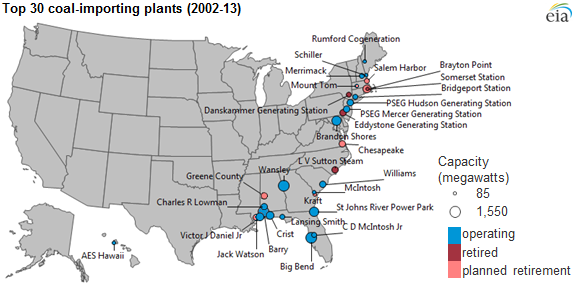
Note: The top 30 coal-importing plants accounted for more than 95% of cumulative coal imports to the power sector from 2002 to 2013.
Furthermore, some imported coal may have lower sulfur content, making it easier for plants to consume coal without exceeding environmental regulations. Technology improvements have partially removed this advantage, as recent installations of flue gas desulfurization equipment at a number of coal-importing plants have provided these generators with additional flexibility to purchase higher-sulfur coal from domestic suppliers.
Coal use at electricity generating plants has been declining in general, as low electricity demand growth and increased competition with natural gas has lessened the demand for coal. The recent decline in coal imports by electric generators in particular is attributable to retirements of coal-fired power plants, decreased utilization of coal-fired power plants, and higher international coal prices compared with domestic prices.
Before 2011, total net summer generating capacity for coal-importing plants was 18,977 megawatts (MW). However, 9% of this capacity was retired between 2011 and 2013, and another 21% of this capacity is planned to retire by 2020. Recent and planned retirements will result in the complete retirement of coal-fired generating capacity at 11 plants and the partial retirement of coal-fired capacity at one additional plant (the Barry plant in Alabama).
The remaining coal-fired electric generators have been used less often in recent years: the average utilization rate of the entire coal fleet declined from 74% in 2006 to 59% in 2013. At plants that consumed imported coal, this drop was larger, falling from a peak of 74% in 2007 to 37% in 2013.
Principal contributor: Mike Mellish
Tags: capacity, coal, consumption/demand, electricity, exports/imports, map, retirements