
Ethanol production capacity little changed in past year
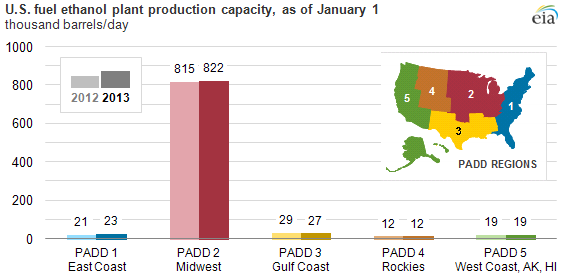
U.S. fuel ethanol production capacity was 13.9 billion gallons per year (903,000 barrels per day), as of January 1, 2013, according to a report released by EIA on May 20, 2013. The report shows a very slight increase in the total capacity of operating ethanol plants compared to January 1, 2012. Most of the existing fuel ethanol capacity is located in the Midwest (PAD District 2).
A total of 193 ethanol plants were operating as of January 1, 2013, compared to 194 plants operating a year earlier. Most fuel ethanol production capacity, about 91%, is located in PADD 2. Total nameplate capacity in PADD 2 is 12.6 billion gallons per year (822,000 barrels per day). The number of plants in this report includes plants that were idled or temporarily shut down during 2012.
The report includes data for the total nameplate production capacity for all operating fuel ethanol production plants as of January 1, 2013. Nameplate production capacity, the measure of capacity tracked by EIA, is the volume of denatured (made unfit for human consumption) fuel ethanol that can be produced during a period of 12 months under normal operating conditions. The total capacities in the report are listed by region (PAD Districts) in both millions of gallons per year and thousands of barrels per day. The report is updated annually.
In two previous reports on ethanol capacity, EIA included data on maximum sustainable production capacity of ethanol plants. Starting with this third report, EIA decided to publish only nameplate production capacities, and will discontinue collection and publication of maximum sustainable capacity data. EIA determined that nameplate capacity is a sufficient measure of available ethanol production capacity, and the additional burden on respondents to report a maximum sustainable capacity number is not justified by the value and utility of the information.
The next EIA annual report on ethanol production capacity is expected to be released during the spring of 2014. The 2014 report will include facility-level nameplate production capacity data, which will increase the transparency of the ethanol industry data.
The capacity data are reported to EIA by respondents on the EIA-819 Monthly Oxygenate Report. The EIA-819 is submitted by all operating fuel ethanol and other oxygenate production plants within the United States. The published ethanol production capacity includes only the ethanol plants that were operating as of January 1, 2013, and does not include plants that were idled or shut down as of that date.
Tags: capacity, ethanol, liquid fuels, production/supply, renewables