
Average summer gasoline prices expected to be slightly lower than in 2012
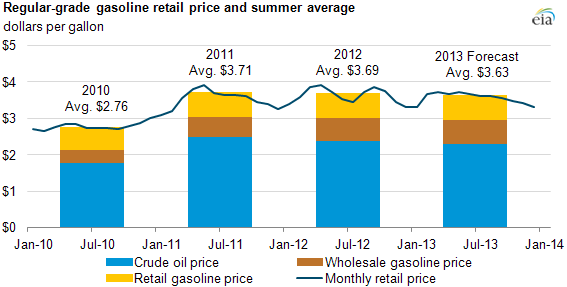
The retail price for regular gasoline is expected to average $3.63 per gallon during this summer driving season, slightly below average prices over the last two summers, according to the U.S. Energy Information Administration's Short-Term Energy Outlook (see chart above). The forecast reflects a small decline in crude oil prices and expected gasoline consumption, as well as higher gasoline inventory levels.
Crude oil prices—which account for two-thirds of the price of gasoline at the pump—are expected to be lower, and thus the main contributor for less-expensive gasoline during the driving season (April through September). The average price of Brent crude oil, a benchmark price closely related to the U.S. wholesale gasoline price, is expected to average $107.50 per barrel this summer, down about $1.50 from last summer.
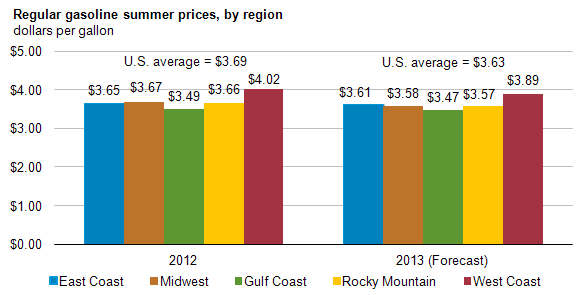
U.S. gasoline prices vary by region, with the West Coast pump price expected to be as much as 26 cents per gallon higher this summer than the national average, while the Gulf Coast could be 16 cents per gallon lower than the national average (see chart below).
U.S. gasoline inventories started the 2013 summer driving season at 220 million barrels, 1 million barrels more than a year ago, but about the same as the five-year average. Although withdrawals of gasoline from inventories were a major source of supply to help meet high fuel demand last summer, the gasoline stock draw this summer is expected to be about one-half of last year's level of 98,000 barrels per day (bbl/d).
The steady drawdown of gasoline inventories seen throughout last summer is not expected to be repeated this summer. Instead, U.S. gasoline inventories are forecast to stabilize by the middle of summer, and end the driving season at almost 210 million barrels, about 8.8 million barrels higher than last summer and 1.7 million barrels above the 5-year average.
Other major characteristics of the 2013 summer gasoline market forecast include:
- Gasoline consumption is expected to be down 20,000 bbl/d (-0.2%), as a 0.3% rise in highway travel is more than offset by improvements in vehicle fuel efficiency.
- Gasoline production may increase by 20,000 bbl/d (0.3%).
- Net imports of gasoline are expected to be 1.1% lower than in 2012.