
Syrian unrest threatens potential role as an energy transit country
Note: Click map to enlarge.
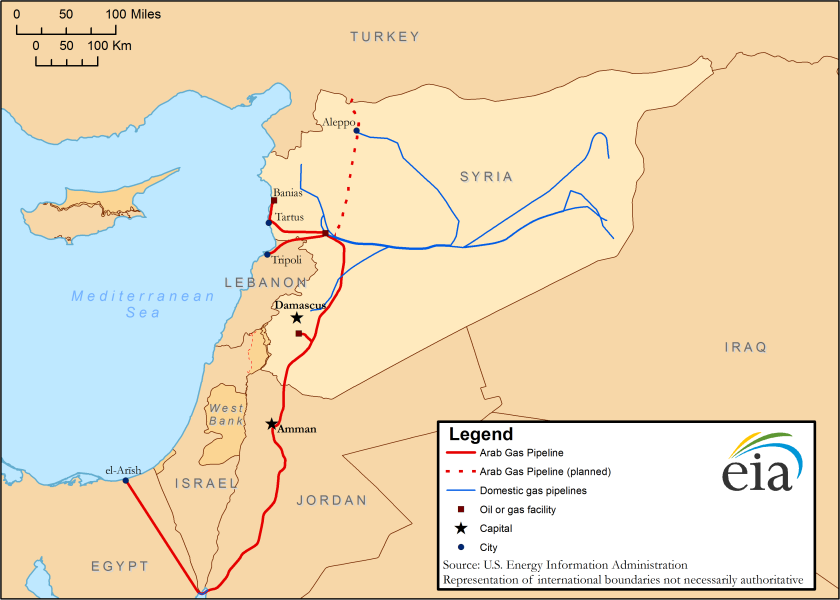
Syria's energy sector has been challenged since the onset of civil discord in March 2011, and it has been severely hindered by continuous fighting between government and opposition forces and the effects of international sanctions. Syria is not a major player in the global energy market, but because of its location, the country has significant potential to be an important energy transit country. The current conflict is preventing Syria from realizing that potential.
Domestically, damage to Syria's energy infrastructure has made it difficult to meet internal energy demand. This difficulty is amplified by Western-led sanctions, which prevent activity by international energy companies. Damage to the electricity transmission network, as well as the cessation of electricity imports from Turkey, have left demand centers undersupplied.
Syria was one of the larger energy producers in the eastern Mediterranean region before the start of civil discord in early 2011. As of October 2012, the Syrian Minister of Petroleum and Mineral Resources estimated the direct and indirect costs of the war to the Syrian oil industry to be $2.9 billion, most of which reflects the loss of Syria's oil exports because of sanctions. Damage to the country's energy infrastructure is estimated at $220 million.
Despite the challenges facing the Syrian energy industry, there are several plans to enhance Syria's role as an energy transit country. Syria has a well-developed domestic pipeline network and has plans to supplement it with further international pipeline development. In May 2011, Iran, Iraq, and Syria agreed that Iranian natural gas would be sent to Syria through Iraq. There are also proposals to build two crude oil pipelines and one natural gas pipeline to flow Iraqi products to the Mediterranean Sea. Another proposed natural gas pipeline would originate in Azerbaijan. However, these attempts to develop international oil, natural gas, and electricity networks and pipelines in the region have stalled, and Syria's attempts to take on a bigger role as an energy transit country are unlikely to make significant progress until the situation in Syria stabilizes.
For more information on the Syrian energy industry, see EIA's Country Analysis Brief on Syria.