
Ethanol producers respond to market conditions
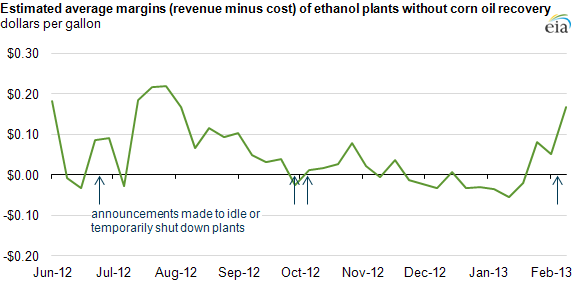
Beginning in summer 2012, the prices of ethanol and corn reached levels where production costs at relatively simple ethanol plants exceeded revenue. These simple plants, which are not able to recover corn oil, make up a diminishing portion of the ethanol industry. Reacting to the market conditions, several ethanol plants temporarily shut down. By January 2013, the number of idled ethanol plants had grown to at least 20.
Relatively simple ethanol plants produce ethanol and distillers grains from corn. More advanced plants are able to recover other products, like corn oil, from a portion of the distillers grains. Ethanol plants with corn oil recovery units are able to earn more revenue, so they usually have higher profit margins than plants without corn oil recovery, even if their production costs are slightly higher.
Over the past few years, margins at plants with corn oil recovery have been 15-20 cents per gallon higher than at plants without it, meaning their margins have remained positive, while margins at plants without corn oil recovery were negative. Each time margins at the simple plants turned negative, several of these less sophisticated plants announced shutdowns, including plants in Nebraska, Illinois, and Minnesota.
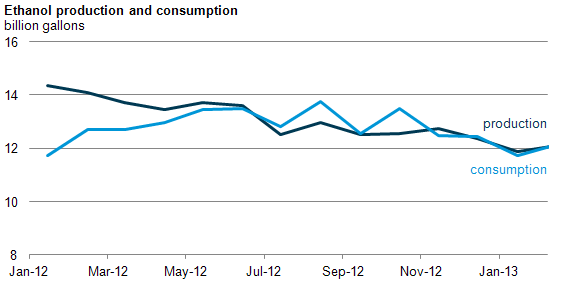
Profit margins also affect ethanol production, prices, and consumption. Following the first set of plant shutdowns, a rise in margins resulted in more domestic ethanol production, which helped reduce prices and resulted in higher ethanol consumption through July. Then, at the beginning of August, a drop in margins led to lower production, reducing ethanol stocks to their lowest level since December 2011. This pattern illustrates how sudden changes in supply (e.g., shutdowns) can lead to short-term market volatility.
During plant shutdowns, some companies have embarked on new capital projects to recover corn oil, while others are performing routine maintenance and looking for opportunities to buy corn economically. Two plants, POET Biorefining in Macon, Missouri, and Abengoa in Madison, Illinois, may add corn oil recovery units in 2013. Others, such as an ADM facility in Walhala, North Dakota, could shut down permanently.
Corn oil recovery is one of several strategies that the ethanol industry is developing to improve margins. Others involve switching to processes that are more advantageous under the renewable fuels standard (RFS). For instance, Aemetis in Keyes, California, is changing its feedstock from corn to sorghum and replacing its natural gas consumption with biomass. Other companies plan to produce butanol rather than ethanol, or integrate cellulosic feedstock, such as wood waste or corn stover (e.g., leaves, stalks, and leftover cobs after the corn harvest). These approaches allow their products to qualify as advanced biofuels under the RFS, a category that specifically excludes ethanol produced from cornstarch, which has been the dominant feedstock for the U.S. ethanol industry.