
Electricity restored to many in the Northeast but outages persist
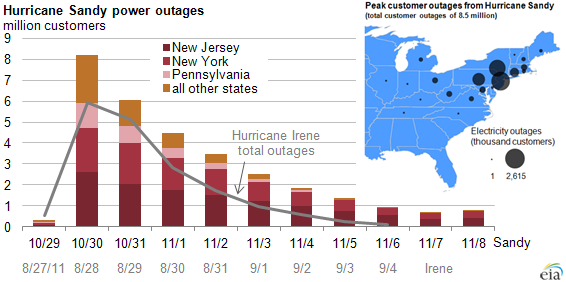
Note: See map for others states affected. Each state's outages are shown at the geographic center of the state rather than the actual location of outages.
Hurricane Sandy caused a massive power outage in the Northeast. According to the Department of Energy's Office of Electricity Reliability and Delivery, about 8.5 million customers (residential, commercial, and industrial) were without power at some point during or after the storm, mostly in parts of the Mid-Atlantic, Northeast, and the Ohio Valley. On 10/30/12, the day after Hurricane Sandy made landfall, 8.2 million customers were without power. For New Jersey, it was the largest power outage in the history of the state. The recovery efforts have been slowed by flood damage and recent snowfall.
As of 11/08/12, power has been restored to around 90% of the customers who experienced an outage, but it is unclear how long it will take to fully restore service. In many areas, structures will need to be repaired or rebuilt before service is restored. High snowfall in recent days has also slowed the recovery efforts in many Northeastern states. Disruptions from Hurricane Sandy exceeded both in magnitude and duration those from Hurricane Irene, which affected millions of Northeastern customers in late August and early September 2011.
The customer outage counts provided by utilities and charted above count the number of meters without service, and not the number of people affected. One meter might represent a single-family home with 4 people, a small apartment building with 150 people, or a commercial building like a gas station, where a power outage could affect many people.
Utilities will likely incur very large labor and equipment costs to restore electric service. Most of these costs will be passed on to retail consumers through higher electricity rates, but price increases could occur over a year or more as state commissions assess the costs through various regulatory processes. Storm-related power outages sometimes raise questions about burying power lines. However, the flooding caused by Hurricane Sandy, especially in the New York City area (where most of the lines are underground), demonstrated that underground transmission and distribution infrastructure are not necessarily immune to damage.
Tags: disruption, electricity, New Jersey, New York, Pennsylvania, prices, states, weather