
Hurricane Francine has taken energy infrastructure offline
This article was updated September 13 to reflect corrections to data and external links.
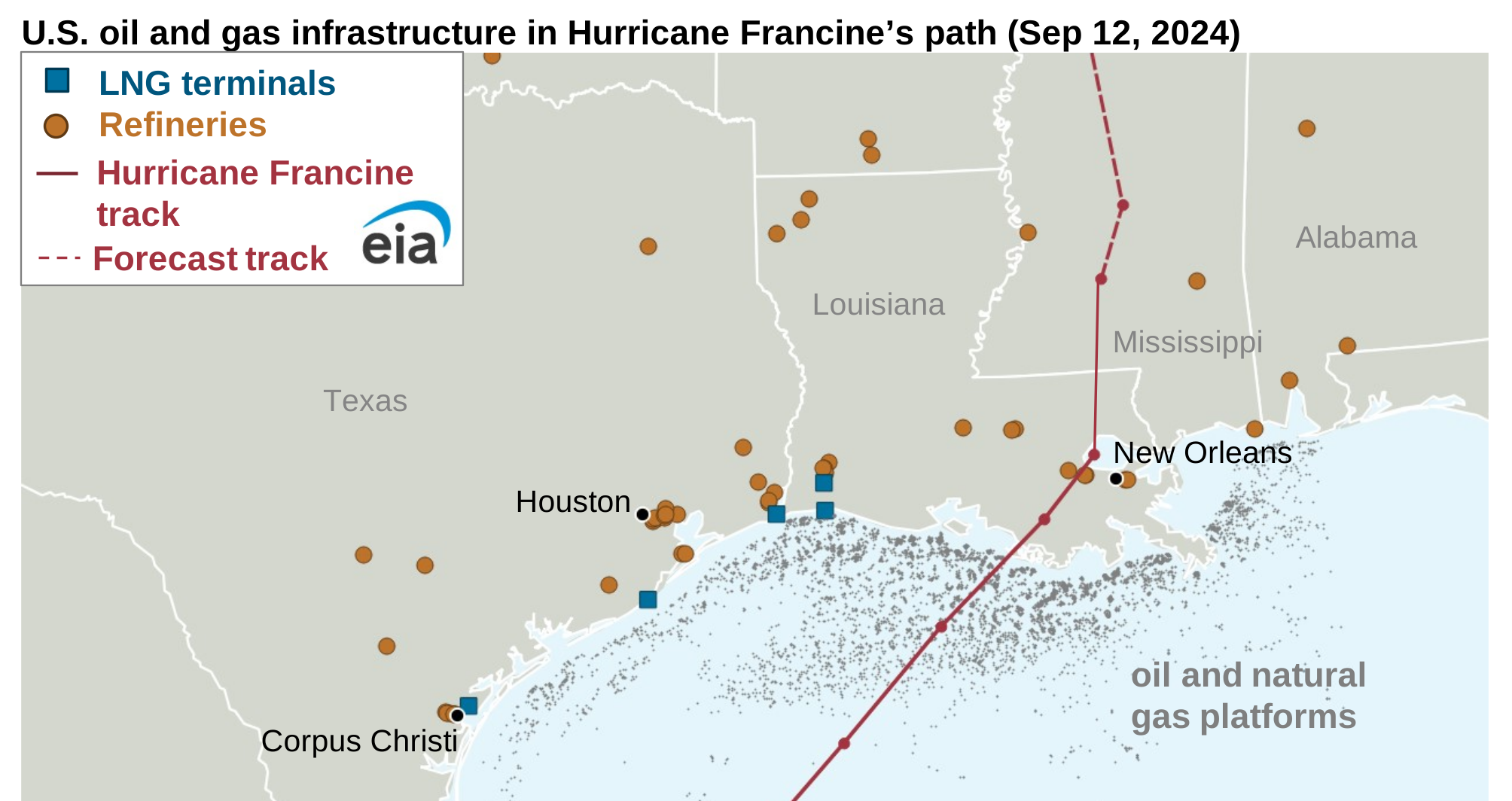
Note: Forecast track is as of September 12, 2024, 9:45 a.m. LNG=liquefied natural gas
Hurricane Francine made landfall Wednesday on the Louisiana coast before being downgraded to a tropical storm, taking some energy infrastructure offline along the U.S. Gulf Coast from Louisiana through Alabama. Detailed information on energy infrastructure and storm risks is available and regularly updated in our U.S. Energy Atlas.
- Electricity: As of Thursday morning, more than 450,000 customers remained without power, mostly in southwestern Louisiana. The rest of Louisiana, Mississippi, and Alabama are also facing outages, with more expected as the storm progresses. Outages could last for up to 10 days. Currently, generator operations are not shut down, but Entergy nuclear plants have entered severe weather procedures.
- Offshore oil and natural gas production: Offshore oil and natural gas operators shut in production as the storm neared, with about 42% of crude oil production and 53% of natural gas production in the Gulf of Mexico offline as of Thursday afternoon, according to data compiled by the Bureau of Safety and Environmental Enforcement (BSEE). Operators of 169 offshore oil and natural gas production platforms in the Gulf of Mexico evacuated their staff, according to BSEE.
- Refining and crude oil exports: Several refineries around Baton Rouge, Lake Charles, and New Orleans, with a combined refinery capacity of about 3 million barrels per day (b/d) or nearly one-sixth of the United States’ refinery capacity, appear to be running at reduced rates. Most notably, ExxonMobil reduced refining activity at its 523,000-b/d Baton Rouge refinery. Several ports on the U.S. Gulf Coast, responsible for over 95% of the United States’ 4 million b/d of crude oil exports, have either closed or imposed restrictions.
- LNG exports: The path of the hurricane did not affect liquefied natural gas (LNG) export terminals equally. Operations continued at terminals in South Texas, and ports were open with restrictions. In South Louisiana, natural gas deliveries to Cameron LNG declined ahead of the hurricane's landfall and were down by 60% (1.3 billion cubic feet per day [Bcf/d]) on Thursday, from 2.2 Bcf/d on Sunday, September 8. The Ports of Cameron and Lake Charles were closed but are being assessed for reopening.
Hurricanes can have differing effects on energy infrastructure, depending on their severity and location.
In July, Hurricane Beryl made its U.S. landfall in Texas. Although the hurricane weakened to a tropical storm within a few hours, its effects on energy infrastructure were felt for several days along the U.S. Gulf Coast.
- Electricity: About 2.7 million Texas electricity customers lost power, some for more than a week, due to damage to energy infrastructure such as transmission and distribution lines. CenterPoint Energy, the utility who experienced the bulk of the damage, faced $1.3 billion dollars in repairs.
- Offshore oil and natural gas production: Hurricane Beryl affected the western part of the Gulf of Mexico, an area with fewer offshore production platforms; at Beryl’s peak, less than 10% of the crude oil and natural gas production was shut in.
- Refining and crude oil exports: Refinery utilization on the U.S. Gulf Coast decreased from 97% to 93% the week ending July 12, as power outages led a few refineries, including Marathon’s 593,000-b/d Galveston Bay refinery, to temporarily reduce production. Power outages also led Explorer Pipeline to temporarily shut down operations between Texas and Oklahoma.
- LNG exports: Natural gas deliveries to LNG terminals in South Texas declined at the time of Hurricane Beryl primarily because Freeport LNG, located south of Houston, shut down operations as a precaution ahead of the hurricane’s landfall. Freeport LNG returned all three liquefaction trains to service on July 28. U.S. LNG exports in July averaged 11.1 Bcf/d, 7% less than exports in June.
Forecasters at AccuWeather recently revised down their expectation for the number of named storms this year after a relatively quiet August and early September.
Principal contributors: Elesia Fasching, Jimmy Troderman, Laia Munoz-Cortijo, Katy Fleury, Susanna Smith