
Policies for compensating behind-the-meter generation vary by State
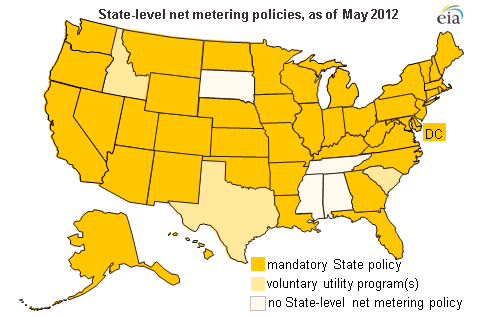
Most States have policies providing incentives for the general public to produce renewable electricity onsite to "spin the meter backwards" (see map above). The terms for such net metering arrangements are typically embodied in a utility tariff.
Net metering tariffs enable customers to use the electricity they generate in excess of their consumption at certain times to offset their use of electricity from the grid at other times. These tariffs are designed to encourage distributed renewable generation—i.e., the generation of small amounts of electricity at the point of ultimate use, rather than the generation of large amounts at a central location, which must then be delivered to the end users. These arrangements describe how an electric utility customer who installs a qualifying generator (typically a rooftop solar array, less often a small wind turbine, or a small combined heat-and-power system) will be compensated by their utility for the electricity they generate in excess of their consumption.
States' net metering policies vary in a number of ways:
- Technology and fuel. States may specify only certain types of generators as eligible for net metering tariffs. In Florida, solar panels are eligible while landfill gas generators are not.
- Capacity limits. Most States place some limit on the capacity of an eligible generator. These vary from the tens of kilowatts to a few megawatts, but run as high as 80 megawatts in New Mexico. Colorado, Arizona, Ohio, and New Jersey have no capacity limit. Utilities are often allowed to cap the size of net metered systems in relation to the host's electricity consumption.
- Aggregate capacity. This limits the total amount of "behind-the-meter" generation on a utility's system eligible for a net metering tariff. California, for instance, allows utilities to decline applications for net metering tariffs if the total amount of net-metered energy would exceed 5% of the utility's total retail sales from the previous year.
- Size or type of power provider. States like Virginia may require public utilities and electric cooperatives to have net metering tariffs, while exempting municipal utilities. Others may require only large utilities to offer net metering tariffs.
- Compensation. Customers effectively receive retail prices for the electricity they generate, as they are charged only for their net electricity usage (their consumption from the distribution system, over and above their onsite generation). In some States, customers receive wholesale prices (which are lower than retail prices) for their excess generation supplied to the distribution system.
The Database of State Incentives for Renewables & Efficiency (DSIRE) provides details on each State's net metering policies.
The wide range of capacity limits is a particularly strong point of variation among States. New Jersey, for example, does not have a capacity limit, but instead has a requirement that the onsite energy production not exceed the customer's annual consumption.
Net metering installations may require additional metering or connection equipment, but typically the utility is responsible for all costs associated with that equipment. In some States, customers have a single meter that spins backwards when they generate more electricity than they consume. Other States require the installation of two meters (one to measure total consumption and one to measure total generation).
Upcoming Today in Energy articles will look at the rapidly increasing number of customers on net metering tariffs, the fuels and technologies they use to generate electricity, and policies driving net metering participation in a few selected States.
Tags: capacity, electricity, generating capacity, generation, map, net metering, renewables, solar, states