
Nearly 5% of U.S. households did not use space heating in 2020, especially in warm regions
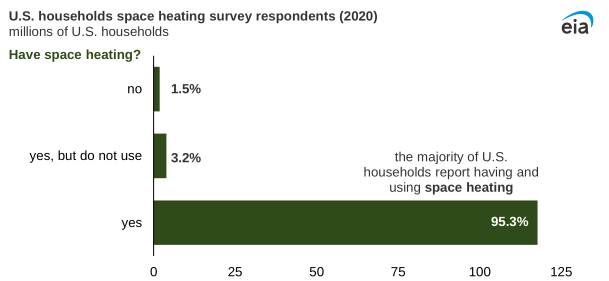
Nearly 5%—or 5.8 million—U.S. households did not use any space-heating equipment in 2020, according to our most recent Residential Energy Consumption Survey (RECS) data. Space-heating equipment is any equipment that generates heat for warmth, such as natural gas furnaces; plug-in, electric space heaters; and wood-burning stoves.
Of the 5.8 million households that did not use heating equipment, the majority—or 3.9 million U.S. households—indicated that they had space-heating equipment but did not use that equipment, accounting for 3.2% of total U.S. households. Another 1.5%—1.9 million households—indicated they did not have any space-heating equipment.
The most common reason that households did not use space heating equipment in 2020 was that the home was located in a warm region and heating was not needed. The number of households that did not use space-heating equipment varied by U.S. census region. In the warmest regions—the South and West—an average of 5% of households did not use their available space-heating equipment. Similarly, 1.9% of households in the South and 3.1% in the West did not have any space-heating equipment.
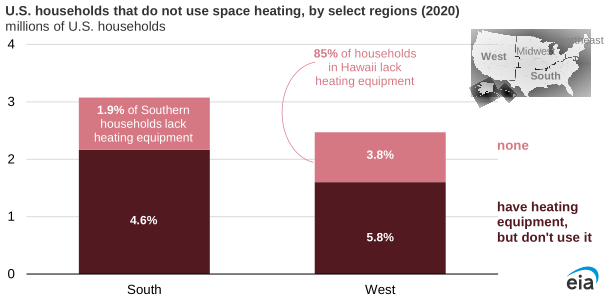
Note: The number of households in the Northeast and Midwest regions that did not use space heating was statistically insignificant.
In Florida, 8% of households do not have any space-heating equipment, and an additional 20% of households have space-heating equipment but do not use it. The majority of households in Hawaii, or 85%, do not have any space-heating equipment.
Although almost 5% of U.S. households do not use space heating, by comparison, 11% of U.S. households do not use air conditioning. It is more common to not have air-conditioning equipment than space-heating equipment.
We collected the 2020 RECS household energy-use data from 18,496 households, which is the largest responding sample in the program’s history. Respondents completed the survey using self-administered web or mail questionnaires during late 2020 and early 2021. For the first time in RECS program history, these data are available at the state level for all 50 states and the District of Columbia. Final household characteristics tables and square footage tables are now available for the 2020 RECS.
Principal contributors: Matthew Sanders, Ross Beall