
Concentrating solar power technologies offer utility-scale power production
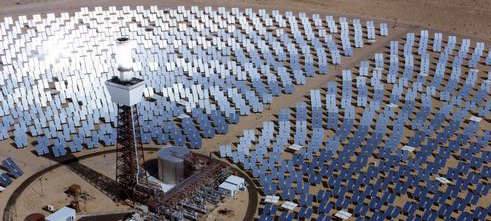
Published by: U.S. Energy Information Administration
Concentrating solar power (CSP) is a utility-scale renewable energy option for generating electricity that is receiving considerable attention in the southwestern United States and other sunbelts worldwide.
Although many people think of photovoltaic (PV) cells when thinking about solar power, CSP technologies that concentrate sunlight to create heat that can be used to generate electricity are also becoming more popular. While there are some PV cells that utilize concentration, the focus of this article and most CSP applications is on technologies where concentrated solar energy heats a fluid, gas, or solid which is then used to generate electricity using steam.
CSP technologies use mirrors to reflect and concentrate sunlight onto receivers that collect the solar energy and convert it to heat. The thermal energy can then be used to produce electricity via a steam turbine or heat engine driving a generator. CSP systems can be classified by how they collect solar energy: power tower systems, linear concentrator systems, and dish/engine systems.
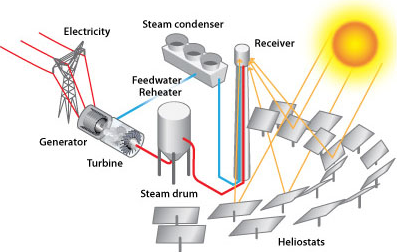
Power tower systems consist of numerous large, flat, sun-tracking mirrors, known as heliostats that focus sunlight onto a receiver at the top of a tower. The heated fluid in the receiver is used to generate steam, which powers a turbine and a generator to produce electricity. Some power towers use water/steam as the heat-transfer fluid. Individual commercial plants can be sized to produce up to 200 megawatts of electricity.
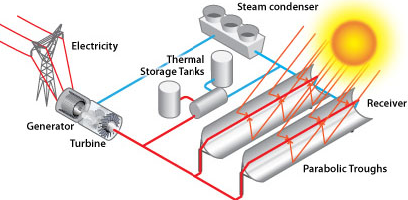
Linear concentrator systems capture the sun's energy with large mirrors that reflect and focus the sunlight onto a linear receiver tube. The receiver contains a fluid that is heated by the sunlight and then used to create steam that spins a turbine generator to produce electricity. Alternatively, steam can be generated directly in the solar field, eliminating the need for costly heat exchangers. Currently, individual systems can generate about 80 megawatts of electricity.
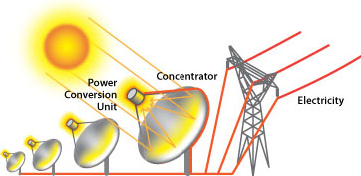
Dish/engine systems use parabolic dishes of mirrors to direct and concentrate sunlight onto a central engine that produces electricity. The dish/engine system produces relatively small amounts of electricity compared to other CSP technologies-typically in the range of 3 to 25 kilowatts.
Please visit the Solar Energy Technologies Program for more information about CSP and other solar technologies.
Published by: U.S. Energy Information Administration
Tags: electricity, renewables, solar