
EIA forecasts the U.S. will import more petroleum than it exports in 2021 and 2022
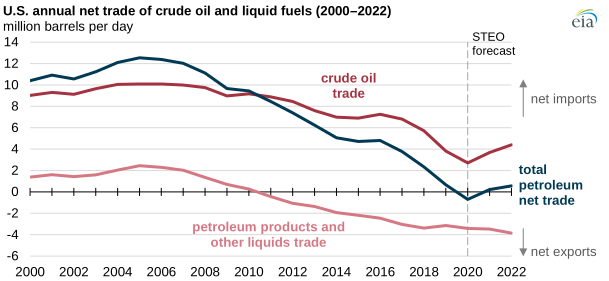
Throughout much of its history, the United States has imported more petroleum (which includes crude oil, refined petroleum products, and other liquids) than it has exported. That status changed in 2020. The U.S. Energy Information Administration’s (EIA) February 2021 Short-Term Energy Outlook (STEO) estimates that 2020 marked the first year that the United States exported more petroleum than it imported on an annual basis. However, largely because of declines in domestic crude oil production and corresponding increases in crude oil imports, EIA expects the United States to return to being a net petroleum importer on an annual basis in both 2021 and 2022.
EIA expects that increasing crude oil imports will drive the growth in net petroleum imports in 2021 and 2022 and more than offset changes in refined product net trade. EIA forecasts that net imports of crude oil will increase from its 2020 average of 2.7 million barrels per day (b/d) to 3.7 million b/d in 2021 and 4.4 million b/d in 2022.
Compared with crude oil trade, net exports of refined petroleum products did not change as much during 2020. On an annual average basis, U.S. net petroleum product exports—distillate fuel oil, hydrocarbon gas liquids, and motor gasoline, among others—averaged 3.2 million b/d in 2019 and 3.4 million b/d in 2020. EIA forecasts that net petroleum product exports will average 3.5 million b/d in 2021 and 3.9 million b/d in 2022 as global demand for petroleum products continues to increase from its recent low point in the first half of 2020.
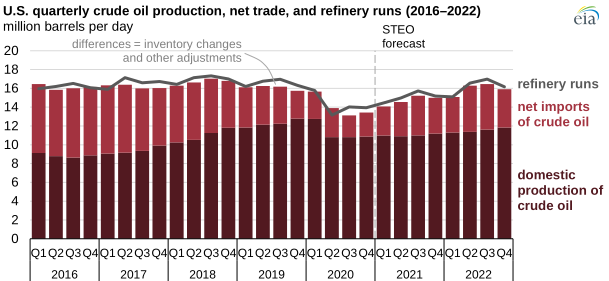
EIA expects that the United States will import more crude oil to fill the widening gap between refinery inputs of crude oil and domestic crude oil production in 2021 and 2022. U.S. crude oil production declined by an estimated 0.9 million b/d (8%) to 11.3 million b/d in 2020 because of well curtailment and a drop in drilling activity related to low crude oil prices.
EIA expects the rising price of crude oil, which started in the fourth quarter of 2020, will contribute to more U.S. crude oil production later this year. EIA forecasts monthly domestic crude oil production will reach 11.3 million b/d by the end of 2021 and 11.9 million b/d by the end of 2022. These values are increases from the most recent monthly average of 11.1 million b/d in November 2020 (based on data in EIA’s Petroleum Supply Monthly) but still lower than the previous peak of 12.9 million b/d in November 2019.
Principal contributors: Stacy MacIntyre, Matt French