
EIA forecasts U.S. petroleum demand will remain below 2019 levels for several more months
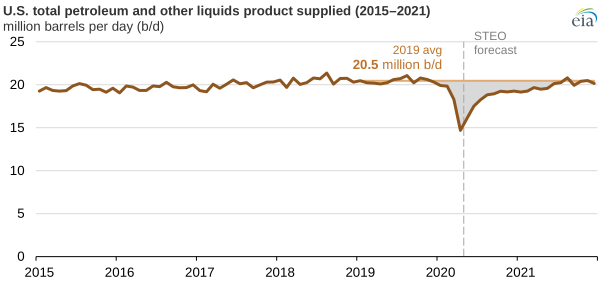
Consumption of U.S. liquid fuels fell in March and April 2020 as a result of reduced travel related to COVID-19 and its mitigation measures. The U.S. Energy Information Administration’s (EIA) July Short-Term Energy Outlook (STEO) forecasts that U.S. consumption of total petroleum and other liquid fuels will continue increasing in the second half of 2020 as economic activity increases, but levels will remain lower than the 2019 average until August 2021.
In April, consumption of liquid fuels in the United States (as measured by product supplied) reached its all-time monthly low since the early 1980s at an average of 14.7 million barrels per day (b/d). Weekly data show consumption of petroleum products has increased as states have relaxed restrictions.
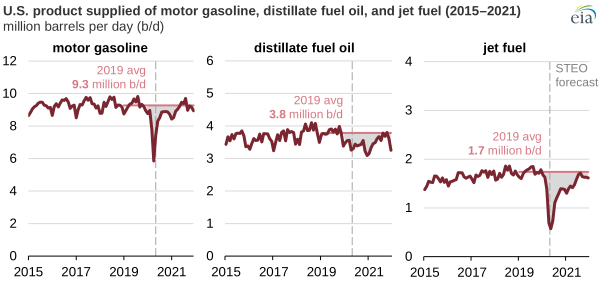
Volumetrically, almost half of the decrease in U.S. consumption of liquid fuels in 2020 has come from reduced motor gasoline use. EIA expects motor gasoline consumption will average 8.3 million b/d in 2020, down 1.0 million b/d (10%) from 2019. In the second half of 2020, a forecast increase in employment leads to an increase in gasoline consumption. EIA assumes employment levels will continue to grow in 2021, and gasoline consumption will increase to 9.1 million b/d, or to about 2% less than its 2019 average.
EIA expects U.S. jet fuel consumption in 2020 to be 31% lower than its 2019 average, a much larger percentage change than gasoline (down 10%) and distillate (also down 10%). U.S. jet fuel consumption fell to an estimated 660,000 b/d in the second quarter of 2020, and EIA expects it to rise to 1.4 million b/d in the fourth quarter of this year. EIA expects jet fuel consumption to continue rising in 2021 and average 1.5 million b/d, or about 12% lower than its 2019 average.
During peak stay-at-home orders, distillate consumption was relatively less affected by COVID-19 mitigation efforts than gasoline or jet fuel consumption. Distillate consumption in the United States is driven by economic activity and is more likely affected by slowing economic growth than by travel restrictions. Distillate fuel is also used in activities that are not as directly affected by restrictions, such as by diesel engines in heavy construction equipment and as heating oil both for space heating in buildings and industrial heating.
More information is available in EIA’s Short-Term Energy Outlook.
Principal contributor: Matt French