
Renewable natural gas increasingly used to meet part of EPA’s renewable fuel requirements
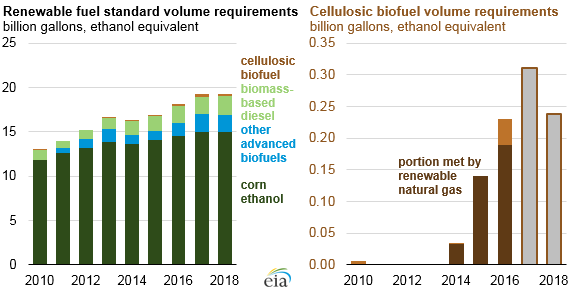
Note: 2018 values reflect final requirements for biomass-based diesel and proposed requirements for other fuels.
Updated October 5, 2017, 1:10 p.m. to correct the graph of RFS volume requirements.
Renewable natural gas (RNG), which is derived from biogas collected at landfills and other facilities, is increasingly used to meet government targets for renewable fuel production. In 2016, about 189 million gallons of RNG were used to meet about 82% of federal targets set specifically for cellulosic biofuel.
The Renewable Fuel Standard (RFS) is a program implemented by the U.S. Environmental Protection Agency (EPA) to promote the incorporation of biofuels in the nation’s fuel supply. Earlier this year, EPA released a proposed rule to determine 2018 renewable volume obligations, and total volumes will remain largely unchanged from 2017 levels. Volume obligations for two categories—advanced biofuel and cellulosic biofuel—were slightly reduced from 2017 levels.
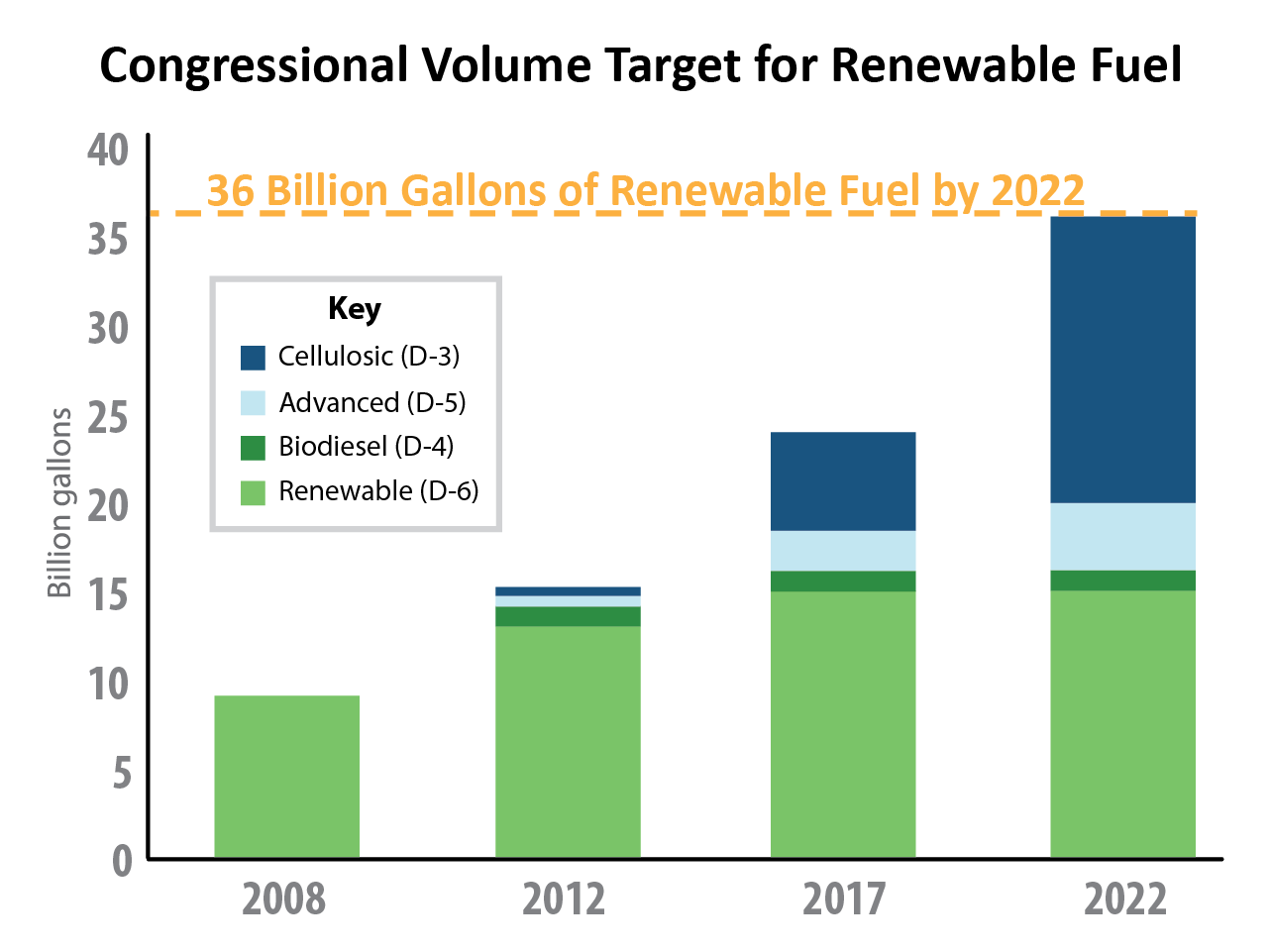
In previous years, when targets for those categories were not met, EPA has exercised its cellulosic biofuel waiver authority to account for shortfalls. In 2016, for instance, only 189 million gallons of cellulosic fuel were produced, less than EPA’s renewable fuel volume requirement of 230 million gallons and far below the original congressional volume target of 4.25 billion gallons for that year.
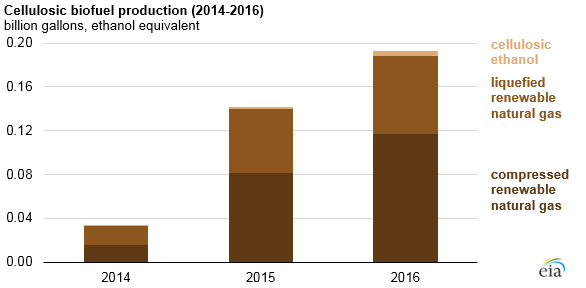
Renewable natural gas is increasingly used to meet the cellulosic biofuel requirement. A 2014 EPA rule expanded the agency’s interpretation of cellulosic biofuel to include biogas consumed as compressed natural gas (CNG) and liquefied natural gas (LNG) produced at landfills, municipal wastewater treatment facility digesters, agricultural digesters, and separated municipal solid waste digesters. These biogases are then processed to be indistinguishable from pipeline-quality natural gas.
Combined production of liquefied RNG and compressed RNG grew from 33 million gallons of ethanol equivalent in 2014 to 189 million gallons in 2016. EPA projects 238 million gallons of cellulosic biofuel will be produced in 2018, of which 221 million gallons are expected to be CNG or LNG derived from renewable natural gas.
Renewable natural gas can be produced several ways. At landfills, organic matter naturally decomposes, and a network of perforated pipes collects landfill gas with the aid of a vacuum. At other waste facilities that involve wastewater effluent, agricultural residues, or separated municipal solid waste, an anaerobic digester unit may be used to break down organic matter. As of June 30, 2017, approximately 50 facilities were registered with EPA to produce RNG, a number that is likely to increase given announced capacity additions.
Landfill biogas typically has an energy content of about 500 British thermal units per standard cubic foot (Btu/scf), which is about half the average energy of natural gas delivered to consumers in 2016. As a result, RNG is often mixed with higher energy-dense gases such as propane to increase its heat content and achieve pipeline-quality natural gas.
RNG can be used to fuel CNG and LNG vehicles, which sometimes serve as alternatives to medium- and heavy-duty vehicles that would otherwise run on diesel fuel. The market for CNG- and LNG-fueled vehicles has increased over time, but it still represents a fraction (0.16% in 2016) of total natural gas consumption. Because RNG is generally more expensive than traditional natural gas, its demand is primarily based on its characteristics as a renewable resource that can help meet reduction targets for greenhouse gas emissions.
Principal contributor: Steve Hanson