
Russia is world's largest producer of crude oil and lease condensate
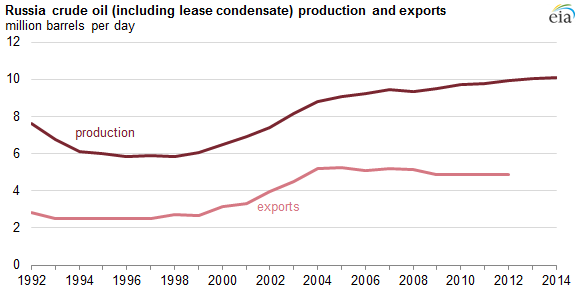
Russia is the world's largest producer of crude oil (including lease condensate) and the second-largest producer of dry natural gas, after the United States. Hydrocarbons play a large role in the Russian economy, as revenue from oil and natural gas production and exports accounts for more than half of Russia's federal budget revenue. However, recent international sanctions on Russia, coupled with low oil prices, have put pressure on the Russian economy.
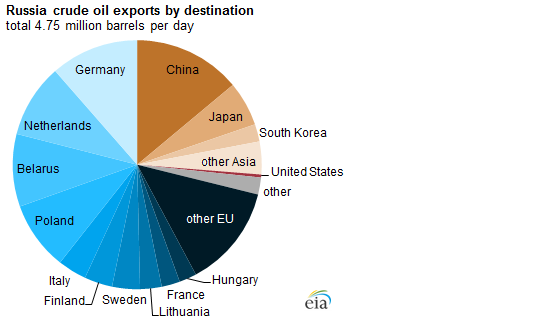
Russia exported more than 4.7 million barrels per day (b/d) of crude oil and lease condensate in 2014, based on data from the Federal Customs Service of Russia. Countries in Asia and Europe received more than 98% of Russia's crude oil exports. Asia accounted for 26% of Russia's crude oil exports, and Europe—which depends on Russia for more than 30% of the region's oil supply—accounted for 72% of Russian crude oil exports. Russia's economy largely depends on energy exports: oil and natural gas revenues accounted for 68% of total export value in 2013.
Much of Russian crude oil production comes from the West Siberia and Urals-Volga regions in central and western Russia, but production in East Siberia and Russia's Far East regions has increased, and oil fields in eastern Russia and in the Russian Arctic stand to play a larger role in the country's future production. However, new projects may be delayed or otherwise affected by economic sanctions currently in place.
In 2014, a series of progressively tighter sanctions, imposed by the United States in response to Russian actions and policies in Ukraine, led to reduced investments in Russia's upstream sector. The sanctions limited the ability of Russian firms to access U.S. capital markets and prohibited the export to Russia of goods, services, or technology in support of deepwater projects, Arctic offshore projects, or shale projects. The European Union also imposed sanctions, although different in some aspects from those imposed by the United States.
These sanctions have halted virtually all involvement in Arctic offshore and shale projects by Western companies. Without such involvement, new Arctic resources are unlikely to be developed. Although this has little immediate effect on Russian production, the sanctions, along with the low world oil prices, have made it more difficult for Russian energy companies to finance new projects.
For more analysis of Russia's energy sector, see EIA's recently released Country Analysis Brief on Russia.
Principal contributor: EIA Staff