U.S. Energy Information Administration logo
Skip to sub-navigation
January 23, 2015

Currency depreciation against the dollar affects oil importers and exporters differently
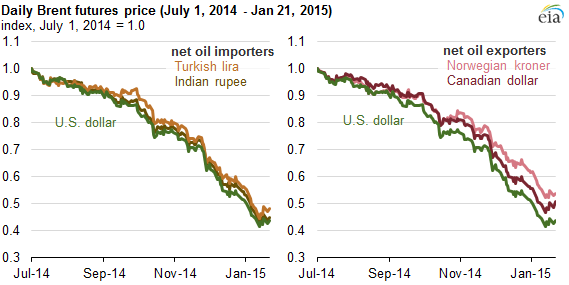
graph of daily Brent futures price, as explained in the article text
Source: U.S. Energy Information Administration, based on Bloomberg

Widely traded futures contracts for North Sea Brent crude oil in global financial markets are typically priced in U.S. dollars (USD). The appreciation, or increase in value, of USD against most other currencies since last summer can either mitigate or exacerbate the effects of the recent sharp decline in USD-denominated crude oil prices, depending on whether a particular country is a net importer or a net exporter of crude oil.

For example, the price of Brent crude since July 1, 2014, declined by 56% through January 21 in USD. However, given the depreciation of the Indian rupee and Turkish lira against the U.S. dollar over the same period, Brent crude prices in terms of those currencies fell by only 55% and 52%, respectively. Turkish and Indian consumers are therefore experiencing a lesser decline in the cost of imported oil products than consumers in countries that use USD or currencies with lesser or no depreciation against the USD.

In contrast, producers in countries that are net oil exporters, like Canada and Norway, find that the percentage decline in the price they receive from oil sales is lower than the decline in USD terms when they convert their oil sales revenue from USD to Canadian dollars or Norwegian kroner. The price of Brent crude in these currencies has fallen only 49% and 46%, respectively, since July. Because some producer expenses, like wages and taxes, are primarily denominated in the home currency of the country where production occurs, the depreciation of the currencies of crude exporters against the USD is partially mitigating the adverse effects on producers of the recent fall in crude prices.

Principal contributor: Jeff Barron

Statistics
Analysis
Tools
Education
News

Petroleum & Other Liquids

Crude oil, gasoline, heating oil, diesel, propane, and other liquids including biofuels and natural gas liquids.

Natural Gas

Exploration and reserves, storage, imports and exports, production, prices, sales.

Electricity

Sales, revenue and prices, power plants, fuel use, stocks, generation, trade, demand & emissions.

Coal

Reserves, production, prices, employment and productivity, distribution, stocks, imports and exports.

Nuclear & Uranium

Uranium fuel, nuclear reactors, generation, spent fuel.

Renewable & Alternative Fuels

Includes hydropower, solar, wind, geothermal, biomass and ethanol.

EIA Survey Forms

Forms EIA uses to collect energy data including descriptions, links to survey instructions, and additional information.

Total Energy

Comprehensive data summaries, comparisons, analysis, and projections integrated across all energy sources.

U.S. States

State energy information, including overviews, rankings, data, and analyses.

International

International energy information, including overviews, rankings, data, and analyses.

Environment

Greenhouse gas data, voluntary reporting, electric power plant emissions.

Data Tools, Apps, & Maps

Tools to customize searches, view specific data sets, study detailed documentation, and access time-series data.

Open Data

EIA's free and open data available as API, Excel add-in, bulk files, and widgets

EIA Beta

Come test out some of the products still in development and let us know what you think!

Open Source Code

EIA's open source code, available on GitHub.

RSS Feeds

Subscribe to feeds for updates on EIA products including Today in Energy and What's New.