
Power sector employment declines, except for renewable electricity generators
Note: 2014 data are preliminary.
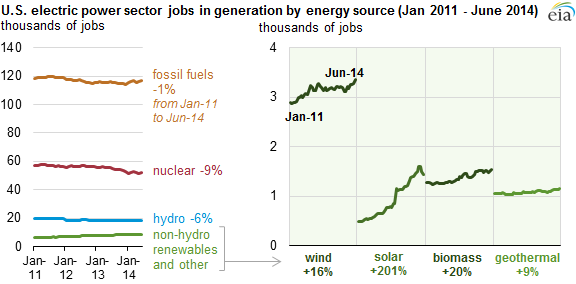
The electric power generation sector lost more than 5,800 jobs from January 2011 through June 2014 despite a gain of nearly 1,800 non-hydro renewable electricity generation jobs, according to the latest data available from the Bureau of Labor Statistics (BLS).
BLS data shown here only reflect jobs in electric power generation, not the jobs associated with electric transmission and distribution systems. Also, jobs involved in the construction of new facilities, processing or transportation of fuels, or behind-the-meter distributed generation installations and service (e.g., solar panel installers) are not counted by BLS as jobs in the electric power sector.
The overall decline in electric power generation jobs coincides with a period in which the United States has seen declining year-over-year electricity sales, driven by energy efficiency improvements, and growth in distributed generation, such as behind-the-meter rooftop solar, among other factors. Additionally, the growth in some types of non-hydro renewable generation, particularly wind and solar, brings relatively few ongoing operations and maintenance jobs.
Fossil fuels. Recent coal plant closures, which were partially offset by new natural gas capacity additions, drove the net decline of 1,750 fossil fuel power generation jobs since 2011. While BLS does not break out the jobs category by fuel, the operations of the new natural gas power plants are less labor intensive than those of the older coal plants that are being displaced. Fossil fuel plants are more geographically dispersed across the country compared to other power generation categories, but the states that have the most fossil fuel jobs are: Texas, Michigan, Florida, Indiana, and Ohio. Fossil fuel jobs include employment at plants fueled by coal, natural gas, and petroleum.
Nuclear. Nuclear power facilities have shed more than 4,900 jobs since 2011. Most of the nuclear generation job losses occurred since January 2013, and are attributable to reactor closures at three locations: Southern California Edison's San Onofre Nuclear Generating Station, Dominion's Kewaunee plant near Green Bay, Wisconsin, and the Duke Energy's Crystal River plant in Florida. Additionally, Entergy announced it will close operations at its Vermont Yankee plant at the end of 2014, which will result in further job losses. South Carolina, Pennsylvania, New York, Michigan, New Jersey, and Illinois are the states with the most nuclear plants.
Renewables. BLS first provided separate data series for renewable generation job categories in 2011. All four categories of non-hydro renewables have seen gains in power generation jobs since 2011. Solar has led the way, with the number of jobs related to the operation of solar generation installations in the electric power sector more than tripling in that timeframe. Although wind jobs have grown at a slower rate than solar since 2011, increasing 16%, there are still more than twice as many wind jobs as solar jobs in the electric power sector.
Renewables jobs are more geographically concentrated than fossil fuel jobs, corresponding to the location of renewable generation capacity. California is home to the most solar, geothermal, and biomass jobs, and the second-most wind jobs behind Texas. Employment at hydroelectric generators fell 6% over this time, but it was still more than double that of all other non-hydro renewable generation employment.
Principal contributor: Robert McManmon
Tags: coal, electricity, nuclear, renewables, solar, wind